
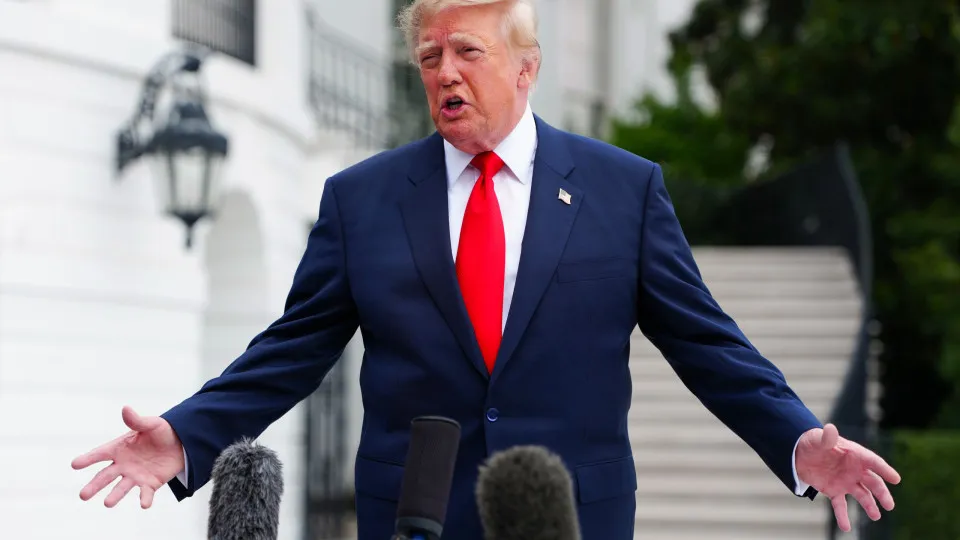
Donald Trump afirmou que “está na altura de a Ucrânia ter um novo presidente” e sugeriu um líder “que consiga chegar a um acordo”. O aviso surge após Zelensky criticar a compra de gasóleo à Rússia, com Trump a acusar Kyiv de “querer criar problemas para o mundo”.
© Aaron Schwartz/Getty Images
10/10/2026
por
O presidente dos Estados Unidos, Donald Trump, afirmou este sábado que “está na altura de a Ucrânia ter um novo presidente”. A declaração surge um dia após ter sido criticado pelo chefe de Estado ucraniano, Volodymyr Zelensky, por ter alcançado um acordo com o seu homólogo russo, Vladimir Putin, em relação à venda de gasóleo
“Sugiro que arranjem um novo líder que consiga chegar a um acordo”, declarou Trump após ter sido questionado por jornalistas na Casa Branca sobre o acordo que alcançou com Vladimir Putin relativo ao fornecimento de gasóleo russo.
“Acho que chegou a altura de a Ucrânia ter um novo presidente”, atirou.
Trump acusou ainda Zelensky de “querer criar problemas no mundo” ao atacar refinarias russas, defendendo que tais ataques tiveram impacto no abastecimento mundial de gasóleo.
“Dissemos-lhes: “Podem fazer o que quiserem à Rússia, mas não ataquem as refinarias, porque isso é um problema à escala mundial que vocês estão a provocar”, disse Trump. “E [Volodymyr Zelenskyy] quer criar problemas para o mundo”.
“Dissemos-lhes: “Façam o que quiserem, mas não ataquem o fornecimento de gasóleo, porque isso representa um grande problema, uma enorme escassez”, acrescentou. “E o que é que ele faz? Vai e ataca o fornecimento de gasóleo”.
E alertou: “É bom que ele pare de uma vez por todas”.
Trump anunciou, na sexta-feira, que alcançou um acordo “transcendental” com Putin que permite que a Rússia forneça “imediatamente” mais de 300.000 toneladas de combustível diesel ao mercado norte-americano e global, “outras 500.000 toneladas durante o mês de novembro e 1.000.000 de toneladas logo a seguir”.
Dependendo do estado das refinarias russas, explicou Trump numa referência velada aos ataques ucranianos à infraestrutura energética de Moscovo, espera-se que a Rússia entregue “num curto período de tempo” três milhões de toneladas de diesel.
Como a Rússia está a sofrer sanções sobre as suas exportações de hidrocarbonetos, o Departamento do Tesouro americano esclareceu de imediato ter concedido uma autorização provisória para esta colocação no mercado.
Em resposta, o presidente ucraniano defendeu que o alívio de sanções sobre gasóleo russo é sinal de “fraqueza” e vai contribuir para Vladimir Putin “travar a guerra durante mais tempo”.
“Qualquer flexibilização das sanções contra a Rússia, sem um acordo claro e duradouro de desanuviamento, é uma fraqueza evidente. Isto joga a favor da Rússia — permitindo-lhe matar mais, travar a guerra durante mais tempo, respeitar ainda menos a América e causar perdas e danos ainda maiores ao mundo”, publicou Zelensky nas redes sociais.
Peace never comes through weakness. Today, representatives of the U.S. Congress were in Kyiv – a bipartisan delegation – and I am grateful to them for visiting Ukraine at such a difficult time. They asked: what is needed to end the war? The answer must be strong. There must be sanctions under the Lindsey Graham bill, there must be support for Ukraine in protecting lives, and there must be pressure on Russia for its war. And today, there was a conversation between the leaders of America and Russia. A conversation that leads to something different. Recently, there was a European decision to lift sanctions on Russian oligarchs. Since then, Russian strikes and the torment of people have only increased. This past week alone, there was a brutal Russian missile strike on a residential building in Pryluky, aerial bombs were dropped on Kramatorsk – on ordinary city buses – and there have been constant attacks on Kyiv’s energy infrastructure and on the life-sustaining infrastructure in Dnipro, Kharkiv, Odesa, and our other cities. Dozens of people have been killed and hundreds wounded. The Russians are compensating for their inability to achieve their objectives on the battlefield with this kind of terror. This year, Russia is weaker on the battlefield than at any other point in the war. That is why Putin is relying on terror. That is why he is relying on attempts to strike backroom deals to secure some form of pressure relief for Russia, in order to buy more time and more opportunities for war. Any easing of sanctions against Russia without a clear and lasting de-escalation agreement with Russia is an obvious weakness. It plays into Russia’s hands – allowing it to kill more, wage war for longer, have even less respect for America, and inflict even greater losses and damage on the world. Ukraine is ready to take symmetrical de-escalatory steps, and the American team knows our position. Our strikes on Russian oil refineries and other oil facilities are a response to Russia’s years-long campaign of terror against Ukraine’s energy sector. Ukraine will not set Russian oil refineries on fire if Russia does not destroy our energy infrastructure. This is the kind of agreement we are proposing to America, and we believe the United States has enough power to achieve such a compromise. Gifts to Putin will not bring peace or any benefit to the civilized world. Russia will “repay” the diesel with further terror and perfidy. Allowing Russia to sell petroleum products is an investment in a war that must be ended, not prolonged. What is needed is real de-escalation with Russia on a reciprocal basis. We count on America’s fair support for our defense of life, for our defense of people in Ukraine – and on the United States having a correspondingly strong conversation with Russia. A strong one, not a weak one.
— Volodymyr Zelenskyy / Володимир Зеленський (@ZelenskyyUa) October 9, 2026
Já durante a madrugada a Ucrânia atacou um terminal petrolífero na região de Rostov, no sul da Rússia.
O ataque causou um incêndio num terminal responsável pelo armazenamento e bombagem de combustível da refinaria de Novoshakhtinsk, que já tinha sido atingida por drones ucranianos em 9 de julho, precisou o canal independente russo Astra.