
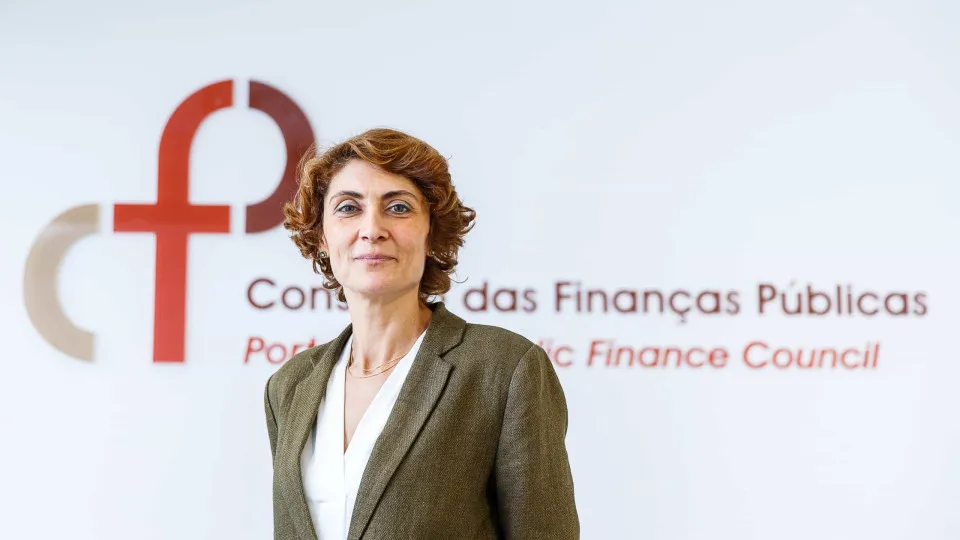
The chairman of the Public Finance Council (CFP), Nazaré da Costa Cabral, today warned of the risks of public expenditure being no longer controlled and the dependence on the state accounts of the current good performance of the economy.
© CFP
07/10/2026
by
Lusa
“ Nwe can lose sight of the control of public expenditure” of the Central Administration, said Nazaré da Costa Cabral, during a hearing of the CFP in the Assembly of the Republic, in the context of the assessment of the State General Account of 2025.
The Commissioner pointed out that the budgetary results of 2025 benefited strongly from the performance of Social Security, due to the favourable development of employment and economic activity, which allowed for an “extraordinary revenue collection capacity”.
However, he warned that this situation should raise concern, since Social Security is heavily dependent on the performance of the economy and this is by nature cyclical.
“This can end,” he said, considering that the state accounts have been “very dependent” on the favorable behavior of the economy in recent years.
Nazaré da Costa Cabral explained that the good performance of revenues can create the idea that public expenditure is controlled, when, in its assessment, there are reasons for doubt, particularly due to the evolution of the actual expenditure of the Central Administration.
“Even in 2025 (...) there was indeed a deterioration in the budget execution of the Central Administration sector,” he said, defending “a great deal of attention” to the management of public expenditure in the coming years.
The president of the CFP highlighted in particular the health area, which classified as a “very critical” sector, pointing out difficulties in forecasting and managing expenditure and referring to initiatives to review expenditure and combat fraud in the National Health Service (SNS).
According to Nazaré da Costa Cabral, these initiatives may represent about EUR 800 million, but the CFP still does not have enough information to assess the results of this expenditure review process.
In the latest Economic and Budgetary Perspectives, the Public Finance Council (CFP) predicted an increase in the growth of the Harmonised Index of Consumer Prices (HICP) of 3.2% in 2026, plus 0.3 percentage points than estimated in April, mainly due to the energy component.
The CFP also anticipated a surplus of 0.2% of the Gross Domestic Product (GDP) this year, although without considering the reduction of IRS, and a deficit of 0.2% in 2027.
According to the update of the Budget and Economic Perspectives 2026-2030, which is in invariant policies, and not considering the announced measure of IRS reduction, the CFP maintains the prospect of a positive balance for this year, which is revised from 0.1% of GDP to 0.2% of GDP.
Thus, Nazaré da Costa Cabral pointed out that Portugal could achieve a zero or close to zero budget balance in the coming years.
It also argued that future budgetary policy decisions, including possible tax relief measures, should be accompanied by effective control of expenditure.
“ If there is an intention to in fact reduce fiscally, they need to be well incorporated into effective expenditure control, because otherwise we will have a problem,” he said.
She considered that public investment currently benefits from the effect of the Recovery and Resilience Plan (PRR), contributing to overcome the historical underinvestment problem.
However, it warned of the need to monitor the impact that the end of the RRP will have on public investment needs, arguing that, in its absence, further effort will be needed.
In this context, it considered it particularly important to control current expenditure, especially the toughest component, which is more difficult to change or reverse.