
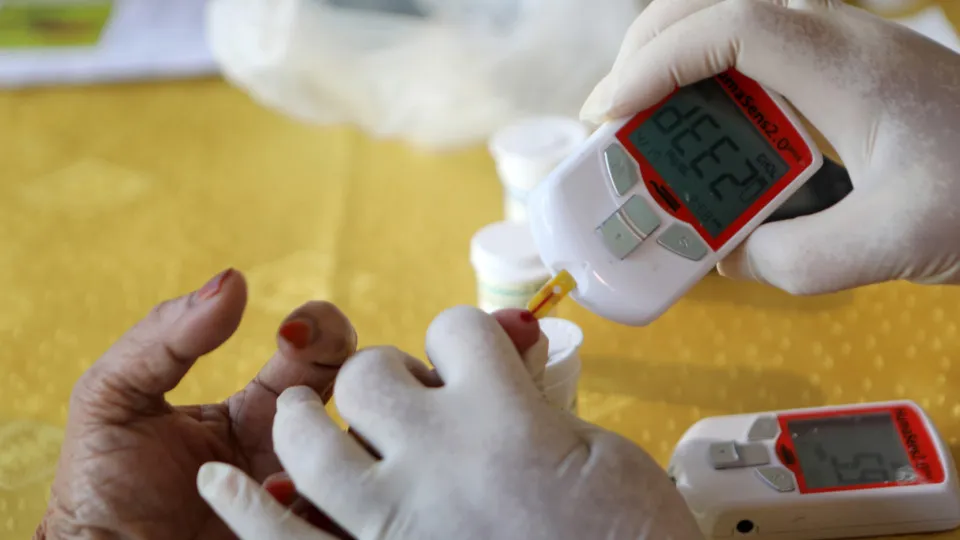
Almost 70,400 new cases of diabetes were recorded in 2025 in primary health care, raising the number of people diagnosed in the SNS to 960.064, the equivalent of 8.9% of users enrolled in the SNS, according to the DGS.
© Lusa
13/11/2026
by
Lusa
Quase 70,400 new cases of diabetes were registered in 2025 in primary health care, increasing to 960.064 the number of people with diagnosis registered in the SNS, the equivalent of 8.9% of users enrolled in the SNS, according to the DGS.
According to data from the National Diabetes Program (DGS) report 2026 today, 70,399 new diabetes diagnosis records were made in 2025, and a further 23,055 records were found compared to 2024.
“The diabetes pandemic continues to have increasing numbers,” Lusa the program’s director, Sónia do Vale, stressed that the number of people identified has been increasing, representing about 8.9% of the people who are followed up in primary health care.
According to Sonia do Vale, it is estimated that about 14% of people between the ages of 20 and 79 have diabetes, which indicates that there are still “many people undiagnosed”.
“ We have been increasing the number of people identified, but we still need to identify more to know who have the disease, to act early and to avoid complications ", defended.
The prevalence of the disease has regional variation, with Alentejo presenting the highest value (10.6%), followed by North (9.9%), Centro 9.6%, Lisboa and Vale do Tejo (7.6%) and Algarve (7.4%), according to the report published on World Diabetes Day, marked on Saturday.
Data indicate that more than 24,000 people with type 1 diabetes are registered, of which 3,161 are under 20 years of age.
“ Since 2023, new registered cases of DT1 have remained relatively stable until the age of 14, with a decrease from 15 to 19 years,” the report said.
Of the assessments of the risk of type 2 diabetes carried out in the CSP of Continental Portugal, 17.2% were classified as presenting moderate risk, 13.4% high risk and 1.1% very high risk.
Sónia do Vale reported that currently about two thirds of eligible people have been screened, and it has been identified that about one third have “an increased risk of developing diabetes in the next 10 years.”.
“ These are also people who worry us and in whom we have to act, especially because most of the cases of diabetes are type 2 diabetes and therefore worth acting on risk factors ", he said.
The responsible woman defended the importance of preventive measures, such as maintaining a healthy diet, practicing physical activity, not smoking and maintaining an adequate weight to avoid the development of the disease.
According to the report, at the end of 2025, 6,294 people were being treated with continuous subcutaneous insulin infusion, of which 5,474 were using Insulin Automatic Administration Systems.
Sonia do Vale highlighted the increase in access to these technologies, following the change in the model for the availability of insulin pumps, which began to be acquired through Community pharmacies in early 2025.
In the pediatric population, coverage increased from 55% in 2024 to 80.5% in 2025.
“ We have been able to give more access to these new types of treatment, which are much more efficient and also greatly improve the quality of life,” he said, believing throughout this year and in the coming years, “the coverage of people with type 1 diabetes can be greatly increased.”.
The Report also points to a reduction in episodes of acute myocardial infarction and stroke in people with diabetes, as well as a decrease in hypoglycaemic episodes.
The program's director highlighted for these results the improvement of control of blood sugar levels and other risk factors, such as hypertension and cholesterol, and current therapeutic “weapons” that allow people to be better controlled.
According to data, diabetes accounted for 2.6% of all deaths in 2024 and the mortality rate before 75 years has decreased significantly since 2020.
In 2025, the identified direct costs of diabetes in the SNS amounted to EUR 748.7 million. “Over the past few years, there has been a significant increase in the burden on medicines and devices. However, in the last year, these charges have been stabilised against the previous year.”.
“In parallel, there is a progressive reduction in the costs of hospitalizations in people with diabetes,” the report notes.
In 2024, 281.349 hospital episodes involving diabetics were recorded. In the episodes where diabetes was the main diagnosis, there were 52,816 episodes in outpatient clinics and 6,963 hospitalizations.