Angola continues among the four States Parties with high levels of contamination by anti-personnel mines and is at risk of failing the goal of completion of mine clearance at the end of 2030, according to the Earth Mine Monitoring report 2026
© Lusa
24/11/2026
by
Lusa
Angola continues among the four States Parties with high levels of contamination by anti-personnel mines and is at risk of failing the goal of completion of mine clearance at the end of 2030, according to the Earth Mine Monitoring report 2026
The report “Landmine Monitor 2026”, presented today in Switzerland, is an annual document prepared by the International Campaign for the Elimination of Landmines (ICBL) and serves as the basis for the regular work of the current 162 signatory countries of the Convention on the Prohibition of the Use, Storage, Production and Transfer of Antipersonnel Mines and on their Destruction, better known as the Otava Treaty.
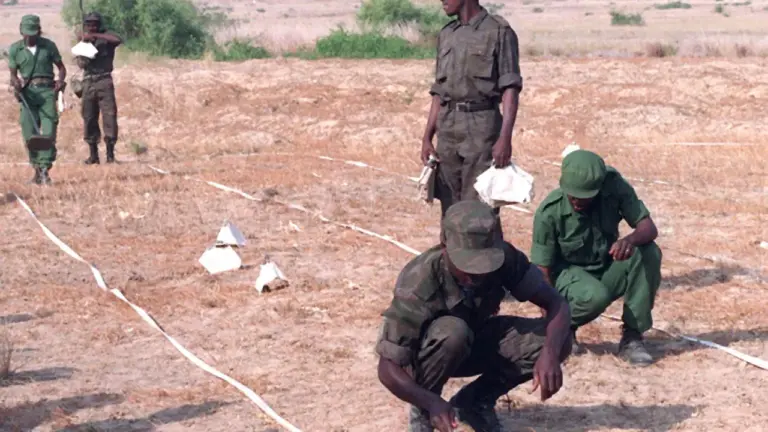
According to ICBL, Angola rehabilitated 6.84 square kilometers and destroyed 9,268 anti-personnel mines, which represents an increase in relation to the 5.55 square kilometers and the 5,680 mines registered in 2024.
In statements to Lusa, Charles Bechara, ICBL communication officer, states that “most of the increase was due to the lifting work, while cleaning itself decreased. Land release continued to fall short of Angola’s annual target, and survey work continues to reveal new cases of contamination.
Faced with this situation, and since Angola’s deadline for demining is fixed, after three extensions, on 31 December 2030, “at the current pace, [Angola] is not on the right path to comply with it” concludes Bechara.
The report also highlights the financing challenges, referring to Angola receiving US$8 million (approximately EUR 7.3 million) in international support in 2025, which represents a reduction of less than 20% compared to 2024.
On the other hand, the country was also affected by the cessation of US subsidies, according to the report.
Still in the Lusophone world in Mozambique – the country declared the completion of mine removal in 2015 and has since reported residual contamination - the report explains a new concern: “Cabo Delgado, where there is a constant threat of improvised explosive devices”.
According to ICBL, in 2025 victims of mines and war waste, including children, were registered in Mozambique.
However, the news often does not specify whether the devices are activated by the victims, so “it is not clear whether they should be considered improvised anti-personnel mines,” says the ICBL.
In Guinea-Bissau, no demining of land was reported in 2025, after the end of international funding at the end of 2024 and the suspension of operations against the mines.
Burkina Faso, Chad, Mauritania and Niger are the other four African States Parties which received no international funding for the mine action in 2025.
Among the conclusions and at diplomatic level, Angola, Mozambique and Brazil were among the 29 countries, together with the European Union, who expressed concern about transfers of anti-personnel mines from the US to Ukraine, says the International Campaign for the Elimination of Mines.
According to this entity, and still in the world of Portuguese, the ICBL notes that Brazil also expressed itself against Ukraine’s attempt to “suspend” the treaty and that Portugal did not report any funding for mine-related actions in 2025.
Cape Verde, São Tomé and Príncipe, East Timor and Equatorial Guinea are not reported as affected by mines, but none of them presented their annual transparency report “three or more years ago,” says the ICBL.
Overall, the report presented today concludes that landmines and remaining war explosives killed or injured more people in 2025 than in any year since 2020.
At least 6,929 people died (10%) more than in 2024, civilians account for 84% of victims and children represent half of all civilian victims.