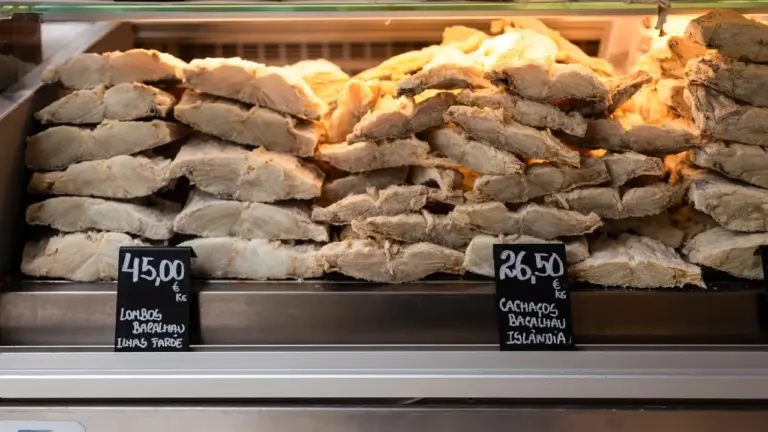
The Cod Industry Association (AIB) warns that if nothing is done, cod can become a luxury food. Data from DECO PROTECT show that the price of large cod rose by 30% compared to last year.
© Shutterstock
23/11/2026
by
News to Minute, Lusa
A Cod Industry Association (AIB) has already warned that, if nothing is done, cod can become a luxury food. How are the prices?
The dECO PROTECTION data on the food basket reveal that, compared to last year, one of the highest price increases was found in products such as large cod (plus 30%, currently costing 22.16 euros per kilogram).
In addition, since 5 January 2022, the highest percentage increases have been those of beef to cook (119% to 12.72 euros per kilogram), the large cod (109% to eur 22,16 per kilogram) and eggs (78% to 2,03 euros).
Cod can get more expensive. Industry calls for intervention
The Cod Industry Association (AIB) argued that this species is in danger of becoming less and less accessible to the consumer because of the weight of customs measures and asked the Government to take a position in Brussels.
“The cod, one of the most emblematic foods of Portuguese gastronomy and traditionally present at the family table, runs the risk of becoming less and less accessible to consumers,” AIB warned, in a note sent to Lusa.
As indicated above, the European customs measures on Russian raw material are at stake, which are creating distortions in competition and penalising the manufacturing industry by increasing the invoice for the consumer. So if nothing is done, cod can become a luxury food, the association indicated.
What factors are conditioning prices?
Tariffs and customs duties according to AIB, they are conditioning traditional sources of supply and changing international trade flows, contributing to a reduction in available supply.
However, the problem is not limited to the raw material directly covered by the measures, since the change in trade flows and the need to find alternative suppliers are creating conditions for “a greater concentration of supply”.
“The case of Norway, whose raw material benefits from a commercial framework that allows access to the European market without the same customs charges, is particularly relevant. This difference creates a competitive asymmetry, allowing Norwegian suppliers to benefit from the valuation of international prices and to strengthen their position on the European market,” he said.
On the other hand, some operators are circumventing the effects of restrictions on Russian products by importing raw material, processing and re-exporting it to the European market, which justifies “a firm reaction from the European authorities”.
Furthermore, the import of Russian raw material for processing into the European Union is subject to a 12% rate, while some products already processed, regardless of origin, can reach the market at zero rate.
The industry thus asks the government to “take a firm stand and intervene” with the European institutions in order to find a solution that corrects “the current distortions and safeguards competitiveness”.
The sector advocates the recovery of the model in force before 2024, ensuring the exemption of input fees for raw material to be transformed into the European Union. AIB, which was established in 1993, represents more than 80% of the cod industry in Portugal. In total, these companies are responsible for 2,500 jobs and generate an annual turnover of more than EUR 500 million.