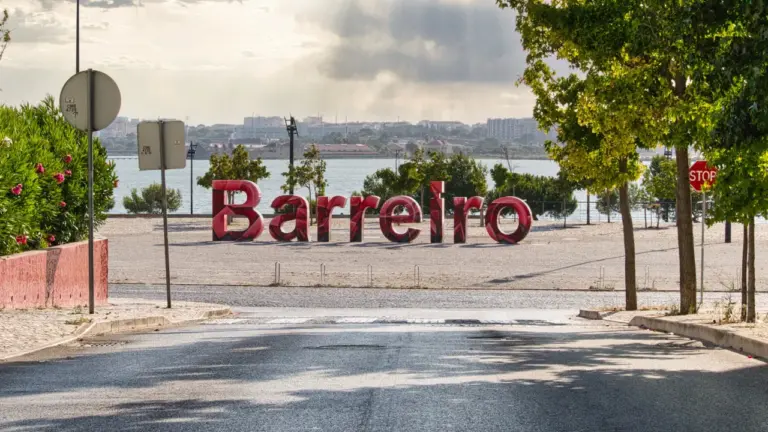
The city of Barreiro, in the district of Setúbal, announced its candidacy to the Portuguese Capital of Culture 2028 with the motto “hard”, inspired by the collective memory of a land of work and the resilience of its people.
© Shutterstock
26/11/2026
by
Lusa
A the city of Barreiro, in the district of Setúbal, announced its candidacy to the Portuguese Capital of Culture 2028 with the motto “hard”, inspired by the collective memory of a land of work and the resilience of its people.
“The Barreiro is always a land of work. Nothing has been given to us, everything has been conquered with work and resilience and that is where the word 'hard' arises, explained Councilwoman Sara Ferreira, on Wednesday, at the public presentation ceremony of an application that has as commissioner the historian and former deputy José Pacheco Pereira.
The councilwoman argued that Barreiro is a city “from which much has been done” and where once the workers sought to drink culture in the various communities scattered throughout the city.
Without seeking a nostalgic view, the candidacy defends a critical and active memory, remembering the struggles and difficulties of the past that shaped the character of the city.
The candidacy commissioner gave as an example of this historical preservation the experience of the “City of Archives” and invoked George Orwell’s famous reflection — inscribed on one of the city walls — on the importance of preserving the past to ensure the future.
“ All totalitarian regimes attack memory, control memory. There is a phrase by George Orwell that is ‘who controls the present controls the past, who controls the past controls the future’ and this phrase, which is written here on a wall of the barreiro, reveals well what the meaning of this candidacy is,” said Pacheco Pereira during the ceremony of presenting the candidacy that took place at the end of Wednesday.
In his speech, Pacheco Pereira made a point of leaving a message to the jury that will choose the Portuguese Capital of Culture 2028, challenging him to change the paradigm that has guided him with choices to fall into cities with monuments.
“Do different, choose different. Here you will find neither churches nor castles, nor historical centers, but a community with strong memory and a strong memory of democracy”, he said.
In statements to the agency Lusa, Pacheco Pereira needed that the central objective of this application is to make the history and resilience of the local population known at national level, summarizing the project in three key words: “memory, democracy and future”.
“If winning, as I think it should win, is an example of a different city, a city with a strong memory and this strong memory helps democracy and the existence of a healthy democracy, based on a strong identity, is the best way to have a future,” Pacheco Pereira said.
To the commissioner of the candidacy, looking at Barreiro’s history “in black times” – as he thinks Portugal and the world are going through – this candidacy is unique because it “is responding to the needs of fighting this blackness”.
The mayor of Barreiro, Frederico Rosa, argued that the candidacy is not exhausted in 2028, but in a long-term strategic vision for the municipality.
The mayor stressed that the municipality does not only view this process as an isolated event, but as an opportunity to align the various cultural agents and strengthen public investment in the area.
According to the mayor, regardless of the final result of the application, the goal is to place artistic creation at the center of urban development, betting on new equipment and the professionalization of local talents.
The project of the Portuguese Capital of Culture was announced in December 2022 by the then Minister of Culture, Pedro Adam and Silva. The first edition took place in Aveiro, in 2024, the second in Braga, in 2025, and Ponta Delgada, city of the island of São Miguel, this year, won cities of the process of choosing the European Capital of Culture, which will be Évora in 2027.
As in previous editions, the Portuguese Capital of Culture will have a state budget of EUR 1 million (Ponta Delgada had an increase of EUR 300,000 due to insularity).
In addition to Barreiro, they have announced the intention to compete for the Portuguese Capital of Culture in 2028 cities such as Almada, Amarante, Covilhã, Loulé, Guarda, Leiria, Óbidos and Setúbal.