
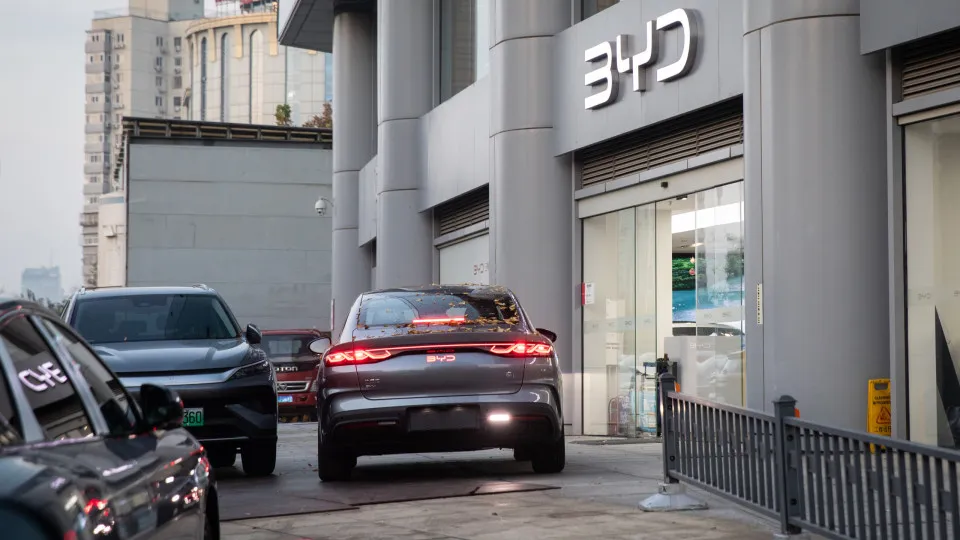
China rejects voluntarily limiting exports of hybrid cars to Europe following an appeal from the European Union. Both sides are trying to avoid further escalation of trade tensions.
© Lusa
08/10/2026
by
Lusa
A China rejected a request from the European Union (EU) to voluntarily limit exports of hybrid cars to the European market at a time when Brussels and Beijing seek to avoid further escalation of trade tensions.
Second, today the Financial Times (FT), quoting two diplomats informed about the negotiations, the European Commission is now considering unilaterally imposing temporary limits on imports of Chinese hybrid vehicles.
The European Commissioner for Trade, Maros Sefcovic, today begins a two-day visit to Beijing, during which he will seek to achieve at least, an agreement to reduce China's growing trade surplus with the EU and avoid the adoption of punitive measures.
The initial Brussels proposal provided that Beijing agreed to limit hybrid car exports to around 15 percent of the european market, against more than one third today, under penalty of facing retaliation measures, including an increase in tariffs.
However, European officials informed the Member States on Wednesday that china rejected the proposal, according to FT.
Safeguard measure? China would not be the only one affected
The European Commission is now studying the application of a temporary commercial safeguard measure, which can be adopted even without evidence of abusive commercial practices.
The mechanism would make it possible to establish a import quota of chinese vehicles, subjecting cars exceeding this limit to high additional tariffs.
The aim of Brussels is to define a volume of imports that Beijing can accept informally, avoiding a retaliatory response.
However, the measure would also have to cover other trading partners, including the United Kingdom, South Korea and Japan, which would receive quotas proportional to their historical export volumes to the EU.
Electric tariff targets since 2024
The increase in Chinese exports of hybrid vehicles occurred after Brussels imposed compensatory duties of up to 35 percent on electric cars made in China, plus the usual tariff of ten percent.
Beijing responded with commercial measures on European products, including brandy, pork and dairy products.
According to France Télécom, European officials believe that negotiations in Beijing will be a failure if no solution is found to increase imports of hybrid cars.
The EU considers the trade deficit with China unsustainable, which reached around eur 1 billion a day.
Germany and France presented a joint document this week demanding a firmer response from the European Commission to Chinese trade practices.
Berlin and Paris have warned of a “massive industrial shock” that is affecting vital sectors for European economies, including pharmaceutical, aerospace, automotive, chemical and machine tools industries.
The two countries advocated the creation of a new instrument to quickly restrict access for certain products to the European market, considering that such a mechanism could also deter possible Chinese retaliations.
A third diplomat quoted by the FT expressed skepticism about the possibilities of successful negotiations.
“If there was an easy answer, we would have found it already. We are asking them to change their whole economic model”, he said.
The talks should also address the decrease in European exports to China, with Brussels pushing Beijing to reduce tariffs for certain products.
Another point of disagreement is the Chinese controls on the export of rare earths, magnets and critical minerals, essential for the automotive, clean technology and defence industries.
According to diplomats, about 90 percent of the licensing applications submitted by European companies have been approved by the Chinese authorities, although the process requires the disclosure of sensitive commercial and industrial information.
Beijing requires Brussels to lift the sanctions imposed on Chinese companies accused of supporting Russia in the war against Ukraine and eliminate export restrictions on advanced technologies, including semiconductor manufacturing equipment from the Dutch company ASML.
The Chinese Ministry of Trade stated last month that it strongly opposes voluntary export restrictions, considering that they violate the rules of the World Trade Organisation and contradict the principles of the market economy and fair competition.