
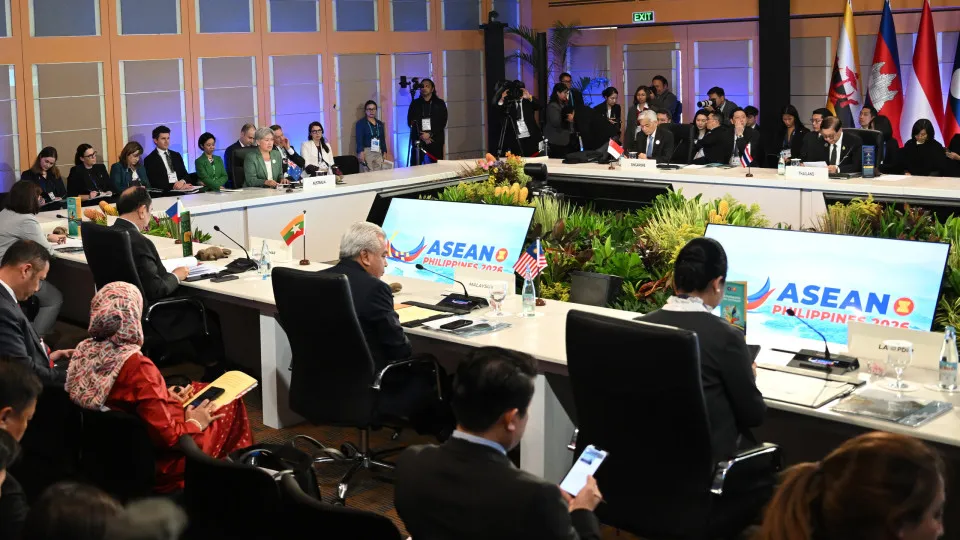
China and South-East Asian countries have made progress in negotiating a code of conduct for the South China Sea, but they will not be able to conclude the agreement this year, according to three regional diplomats.
© Lusa
11/11/2026
by
Lusa
A China and South-East Asian countries have made progress in negotiating a code of conduct for the South China Sea, but they will not be able to conclude the agreement this year, according to three regional diplomats.
China and the Association of South-East Asian Nations (ASEAN) started negotiations in 2005 on the so-called “code of conduct”, in order to prevent occasional clashes in the disputed waters from becoming a major conflict capable of threatening Asian economies.
The agreement mainly provides for containment measures and seeks to discourage aggressive actions that could trigger confrontations on this important world trade route.
After years of closed-door negotiations, sometimes delayed due to clashes in disputed waters, Beijing and ASEAN agreed in 2023 to speed up the process and conclude talks by the end of this year.
Three high-level diplomats from Southeast Asia, with direct knowledge of the negotiations, told the Associated Press News Agency today that after the last round of talks held in October, the two parties reached a provisional agreement on about 80% of the paragraphs to be included in the document.
The main differences now concern the geographical area covered by the agreement, the definition of certain terms considered sensitive and the question of whether the code should be legally binding.
The diplomats spoke anonymously because they were not allowed to discuss the negotiations publicly, and did not provide further details.
The talks will therefore have to continue in 2027 when Singapore takes over the rotating presidency of ASEAN.
The Philippines, which chaired the organisation this year, has promoted a greater number of meetings, at least once a month, allowing negotiators to have more time to try to overcome differences, according to the same sources.
China and Malaysia, which currently coordinates ASEAN's relations with Beijing, jointly led at least ten important rounds of negotiations this year.
The state of the talks and recurrent incidents in the South China Sea should be prominent at the annual ASEAN summit, which starts this weekend in Manila.
After the meeting, the leaders of the organization should meet leaders from Asian and Western countries, including the United States and China.
Beijing claims sovereignty over much of the South China Sea, a strategic region where its territorial claims overlap those of Brunei, Malaysia, the Philippines and Vietnam, all members of ASEAN and Taiwan.
The region, crossed by some of the world's main trade routes, can also house important underwater oil and natural gas reserves.
In recent years, clashes have intensified mainly between the Chinese and Filipino coast guard and navy forces, around disputed reefs and sandbanks.
In 1988, a clash between Chinese and Vietnamese forces over a disputed reef caused the death of dozens of Vietnamese military personnel in one of the bloodiest episodes known in the South China Sea.
Territorial disputes have been a major focus of tension in Asia for decades and have also become a sensitive front of the strategic rivalry between Washington and Beijing.
The United States has reiterated that under the mutual defense treaty with the Philippines, its oldest formal ally in Asia, they are obliged to intervene in the event of an armed attack against Philippine forces, including in the South China Sea.
China has warned Washington to stay away from what it considers an exclusively Asian dispute.
ASEAN was founded in 1967 by Indonesia, Singapore, Thailand, Malaysia and the Philippines. Other countries such as Brunei Darussalam, Cambodia, Laos, Myanmar (former Burma), Vietnam and East Timor have since last year.