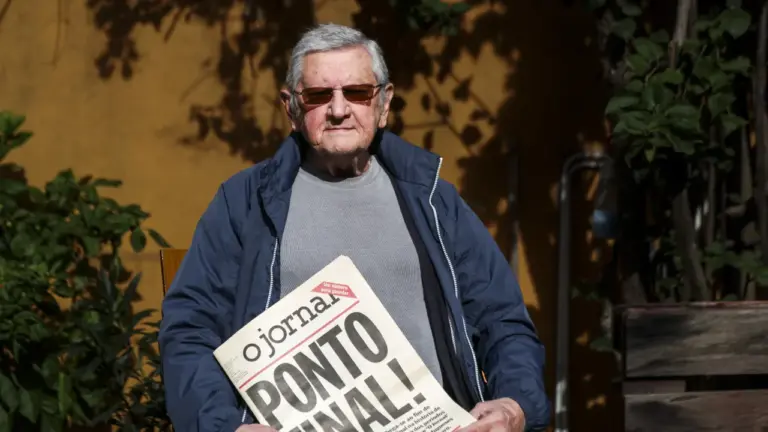
The co-founder of O Jornal, José Silva Pinto, hopes that the book on the history of the newspaper will be remembered as a tribute to journalists and that the council “look for the truth” will be followed by young professionals.
© Lusa
24/11/2026
by
Lusa
O confounder of O Jornal José Silva Pinto says he expects, in an interview with Lusa, that the book on title is remembered with a tribute to journalists and the advice he gives to young professionals is “seek the truth”.
The 84-year-old journalist has just released “The Journal: A Parallel Adventure”, in which he tells the story of the project that was launched in May 1975 – which is part of the history of Portuguese journalism – and where he was deputy director and director.
Asked as I would like this book to be remembered, José Silva Pinto says: “I would like it to be remembered as a tribute to journalists”.
The report says, “it is the essence of journalism”, the “most emblematic discipline”, recalling that for many years he was a reporter.
“ When entering this adventure of O Jornal, a part of these characteristics, of these activities, was somehow parallel to the administrative part also that I was the only one, at least that was what my comrades said, that had some way to do it ", reports.
About the advice you would give young journalists, the recipe is “look for the truth, which is a difficult thing”.
This implies, “naturally, a search and a lot of work and I think that this is, in my opinion, the essential advice I would give to a journalist”, he reinforces.
Regarding the future of journalism, he says with “concern, referring to a visible part of the activity that “is increasingly influenced by the right-wing drift that is ravaging the world.”.
“ It seems to me that there is also in journalism a kind of unconsciousness of what is happening, it causes me some concern”, confesses José Silva Pinto, who recalls that when the profession began there were no schools of journalism.
Currently, there are “several journalism courses, but I am convinced that, as far as I can see, there is much that remains for theory and not for practice”.
José Silva Pinto was “the first Portuguese journalist who traveled on a papal plane with João Paulo II to Mozambique”.
On Portuguese politics, he highlights the “class of politicians of the time”, whether they were a party.
“In my long experience, I had (...) the possibility of attending debates, so let us call, in the so-called National Assembly, before 25 April”, in which there was a single party, the National Union, “then transformed into, or renamed as the People’s National Assembly, in which there were obviously well-placed gentlemen, but there was a civilized treatment among them”, he says.
Now, “if I make a comparison today with what is happening in the [Repulica] Assembly today, with that right part that I consider to be a kind of pigsty, it is incomparable,” he stresses.
Asked to indicate politicians with whom he dealt most in his time, José Silva Pinto points out from Sá Carneiro, Mário Soares, Adelino Amaro da Costa, Sousa Franco and Freitas do Amaral.
“ They are figures that occur to me suddenly, with greater clarity ", says.
About projects linked to weekly The Journal that remained undone, points out that “there were several”.
“There is one thing that is important there to stress that it is our essential participation in the creation of the TSF and also at the beginning of the beginnings of the SCI”, he says.
The link to the TSF “had lived for a few years, we were still there in the capital,” while “SIC was just a symbolic thing, but there was another project we would have liked to have carried out, namely a daily newspaper,” he says.
“ We even had a contract with Le Monde, for which we paid 100 bucks, which at the time was money, but ended up not revenge because there were no conditions”.
About his entry into journalism, José Silva Pinto says that “it was an almost instinctive thing”.
Born in Almada, he lost his father when he was nine and his mother when he was 17, and that's where he took his first steps in a newspaper run by a parish prior.
“I started writing there (...) and then I began to have as a goal” that this “would be something I would like to be”, he recalls.
The first job itself was as a collaborator in Flame magazine, “where 100 shields were paid for a page, 150 for two and 400 shields” for what they called “the survey, which was a little longer”, he concludes.