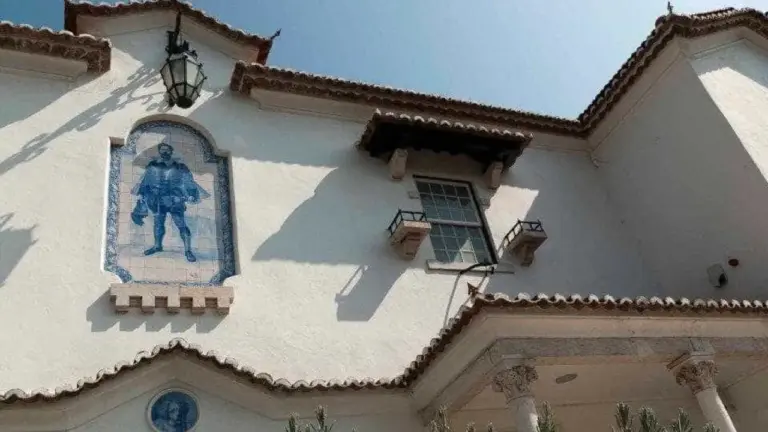
The exhibition Japonismo de Bordalo, to be inaugurated on Thursday at the Bordalo Pinheiro Museum in Lisbon, explores the influences of Japanese art in the work of the creator of Zé Povinho.
© Facebok
25/11/2026
by
Lusa
Bordalo Pinheiro
A exhibition “Japanismo de Bordalo”, to be inaugurated on Thursday, at the Bordalo Pinheiro Museum in Lisbon, explores the influences of Japanese art in the work of the creator of Zé Povinho.
The exhibition, curated by art historian Pedro Bebiano Braga, brings together about 150 pieces, among the various expressions of art that Bordalo Pinheiro developed, from caricature to graphic arts, decoration and ceramics, and will be patent until September 26 of next year.
Rafael Bordalo Pinheiro (1846-1906), “both in caricature and in ceramics, accompanied the innovation and modernity of what was done in Europe or even in America. Bordalo was aware of what was done ", highlighted Pedro Bebiano Braga à Lusa.
“ This exhibition was structured around this fashion of Japonism, which takes place mainly in the last quarter of the nineteenth century. And I began to notice that Bordalo had, in some pieces of his work, a Japanese influence. Then I began to look for more, to know more about the Japanese art of that period and to try to understand how this happened in Western art ", said Bebiano Braga.
“ It was known that there was Japonism, but, in fact, in Portugal, it is a very new topic. And, as I know, there has never been an exhibition on Japonism with a Portuguese artist”, said the curator, who pointed out an unprecedented line in historiographical investigation about the artist.
“It’s a surprise to the art historiography itself, to come across an artist who accompanies and is interested in the novelties and who, at the same time, interiorizes and makes it a personal form of expression of his art”.
The show is divided into four parts, explained Braga to Lusa.
The first, “Japanism to laugh”, refers to the caricatures and self-representations of Bordalo, where “many politicians and other personalities are transvested with kimonos, with vents and fans elsewhere.
The second, “Graphic Japansices”, shows “a new perspective, the silhouettes and emblems, namely the ‘Mon’, corresponding Japanese to the western noble coats, and also another way of representing animals and vegetables”.
This new perspective, explained Braga, was “an innovative contribution in the composition of pages, binding covers, programs or menus”.
In this Japanese influence, “Bordalo will use some objects, such as fans or windscreens, to draw on these fans as if they were pages. It makes the fan as if the caricatures were [your] ornamentation or that windshield, and that, say, is a very funny thing, because it uses the object as if it were the talking object.”.
The third part of the exhibition, “Japan fashion”, presents decorations to “Japan fashion”. Rafael Bordalo Pinheiro was also a decorator, namely, author of ephemeral decorations, explained Bebiano Braga, where “among other pieces, the screens and blinds came out of the same taste”.
The fourth part, “Haikus in Ceramics”, includes modelled by Bordalo at the Faianças da Caldas da Rainha Factory.
The ‘haikus’, short poems of 17 syllables, are expressed in the placement, in a ceramic object, of a decorative detail, an insect, a lizard, a stem, etc., the art historian explained. “Bordalo makes small ceramic poems”. “They are visual poems”.
According to Bebiano Braga, this is “the capture of the moment of the real, but a real poetic, a real sensitive, that [Bordalo] manages to transpose into the ceramics”.
Another influence from Japan, to which Bordalo resorts are the “machuchados”. On this technique, he explained: “Imagine a pitcher in almost one ball. He hurts the clay until it looks almost like a disforme bag. This was often the case in Japanese ceramic ovens.”.
“ The Japanese, when, for example, there is a disaster in the oven where the pieces were glued together or bruised, have a concept of finding this beauty in chance. And therefore, because the way came out badly, they do not reject it. On the contrary, they value it. And then they even start to make forms of them by purposefully injured”.
“The Bordalo will do it. He'll try to deconstruct the shape. And that's from an enormous modernity to ceramics. Because, for centuries, the tradition was to make a perfect shape, round or square, and then decorate it. Bordalo will bring this novelty from Japan, which is the deconstruction of the shape, the injured form and, on the other hand, also seek the pure form, capturing instant poetics of the real, experiencing shapes and glazed”.
Another technique that mattered was that of the “slips”, that “there are several color paints flowing [as decoration on an object] and that gives it an aqueous air, it looks like something almost liquid on the surface of the piece,” he explained.
Another import of the rising sun empire was ‘ukiyo-e’, which can be translated as ‘floating world’.
“ They are images of the floating world [a fleeting world], which began to be the images that were made by Japanese artists, especially by recorders, who printed colored paper sheets in which they represented images of, for example, very well known actors and which, in the background, are a floating world, a pleasant world”.
“ They could be actors, but also a little bug flying, a tea ceremony. They can be simple, everyday things that are immobilized as moments of pleasure, a sunset, a moonrise, an insect or a blooming flower”.
“ It is a thematic technique, which began to be mainly of engraving, because they were those that were easier to reproduce, but that later extended to other forms, without being engraving, to other supports ", explained.
In the fourth core of the exhibition, in the area “Circulations”, there are pieces of Japanese art, produced in Japan, “or here in the West, but in the way of that, generating a web of circulations that fed the material culture and inspiration of many artists”.
Japanese art influenced the West from 1870, when Japanese ports opened up to international trade, according to Bebiano Braga. And its influence “is noted above all in the ‘new art’ style”.
Pedro Bebiano Braga studied Art History at the Faculdade de Ciências Sociais e Humanas, from Universidade Nova de Lisboa, where he was a student of José-Augusto França, and has been investigating this subject for 20 years, “initially even by carolice”.
“ In this investigation, I found more than half a hundred references in the Japanese engraving that Bordalo used to make his own engraving”.
This exhibition is “very interesting, because the pieces will be seen in a way that they have never been shown, because no one has ever pointed it out [the Japonism], especially in the graphic part of the Bordalo”, he concluded.
“Japanism of Bordalo”, at the Bordalo Pinheiro Museum in Lisbon, is inaugurated on Thursday and can be seen until September 26, 2027.