
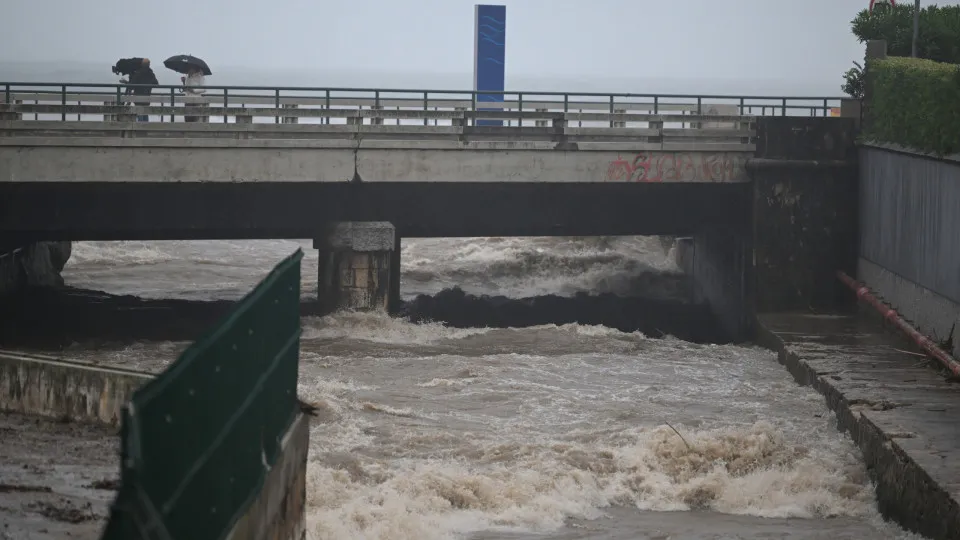
The depression Charles, which initially passed through the Madeira archipelago before entering mainland Portugal, went towards Spain at the end of this afternoon, after causing more than 1,600 occurrences, mainly floods, but without fatalities.
© Zed Jameson/Anadolu via Getty Images
11/11/2026
by
Lusa
A depression Charles, who initially went through the Madeira archipelago before entering mainland Portugal, headed towards Spain at the end of this afternoon, after causing more than 1,600 occurrences, especially floods, but without fatalities.
“It’s better to be safe than sorry,” said Prime Minister Luís Montenegro, stressing that “fortunately” the storm lost power in relation to the initial forecasts.
In statements to journalists, at 7:30 p.m., after the “briefing” of the National Emergency and Civil Protection Authority (ANEPC), in Carnaxide, Oeiras, Lisbon district, the head of the government considered that this test gave the Portuguese “a great confidence in the civil protection system” and praised the Minister of Internal Administration, Luís Neves, who was at his side, for the “exceptional appetite” for operational and political coordination.
By early afternoon, Minister Luís Neves had already rejected excessive zeal in preventing depression Charles.
By decision of the Government, mainland Portugal is now in a state of alert until 11:59 p.m., and non-essential public schools and services have been closed and recommended to the population to limit travel and, if possible, to telework.
Contrary to what was initially predicted, the storm with heavy rain, intense wind and sea agitation, which motivated red weather warnings (the most serious) to the Madeira region and to several districts of the continent, lost power during the morning and divided into two cores of low pressure, following one towards Lisbon and another towards the Algarve.
In the middle of the afternoon, the Algarve was the only region to maintain red weather warnings, due to rain and wind, which were, however, deactivated, with depression Charles on his way to Spain.
The island of Madeira was the first to be hit by the storm, even on Tuesday night, with the Regional Civil Protection Service registered until 18:40 today a total of 328 occurrences, including mass landslides (88), falls of trees (50) and road cleaning (34).
The most serious situation occurred in the parish of São Roque, Funchal, where a 78-year-old man was rescued alive after being dragged by the water of a river that had overflowed with rain, and there was also a record of a family that had the house flooded in Serra d’Água, Ribeira Brava, and some people held at home because the road was insurmountable for a few hours.
In the territory of the continent, the storm affected mainly the regions of Lisbon, Setúbal and Algarve, with floods, falls from trees and landslides.
On a 7 p.m. balance sheet, the ANEPC reported that 1,630 occurrences associated with bad weather, especially floods (881), were accounted for by one assisted victim and four rescued following the fall of roofs.
At the press conference, the Portuguese Institute of the Sea and Atmosphere (IPMA) considered appropriate the prevention measures adopted on Tuesday for depression Charles, with the maximum burst of 123 kilometers per hour registered in Foia, in the Serra de Monchique, in the Algarve.
Twelve people had to leave the houses where they reside due to infiltrations and entrance of water through the roofs in the municipality of Palmela, in the district of Setúbal, but they are all relocated, revealed to Lusa source of the City Hall.
There are also reports of displaced persons as a result of the storm, namely four in Silves, in the Algarve, and three in the lower part of Alverca, in Vila Franca de Xira, in the district of Lisbon.
As for electricity failures, only “some hundred” of E-Networks’ customers were today out of power supply by 7:30, predicting the company that “in the coming hours the situation will be normal.”.
By 6.30 p.m., nearly 400 flights were cancelled at airports in Lisbon, Porto, Faro and Madeira due to bad weather, according to a balance sheet of ANA airport manager.
During the day, there were still roads and tunnels cut across the country, and the rail traffic was also affected punctually.
On the other hand, circulation on the Vasco da Gama bridges and April 25 was normalized at the end of this afternoon, with the replacement of the usual maximum speed limits, respectively, of 120 and 70 kilometers per hour, Lusoponte reported.