
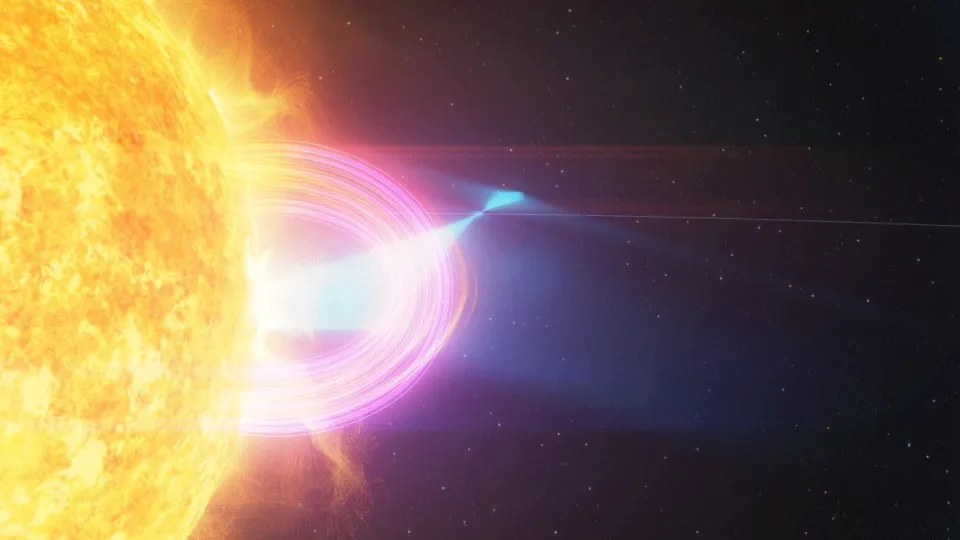
Astronomers first detected pulses of radio waves from a white dwarf star orbiting a Sun-like star, it was released today.
© Reproduction
12/11/2026
by
Lusa
Astronomes first detected pulses of radio waves coming from a white dwarf star orbiting a Sun-like star, it was released today.
Normally, radio pulses (low frequency electromagnetic radiation signals) are observed in star systems with red dwarfs, smaller and colder stars, according to scientists.
A white dwarf is the remaining dense nucleus of a star like the Sun.
“ It is the first time that the impulses are clear enough to see the white dwarf moving in its orbit around its companion, which allows us to know that the radio impulses come from a region close to the white dwarf, or possibly even from the white dwarf itself,” said the work leader, Sam McSweeney, quoted in a statement by the International Center for Research in Radioastronomy, Australia.
According to the authors of the study, the radio pulses emitted by the white dwarf allowed detecting star eruptions in the Sun-like star.
Star eruptions are brief increases in the brightness of a star caused by the release of large amounts of magnetic energy, which on Earth cause the boreal and austral auroras.
“It’s amazing how through radio wavelengths we can detect storms in a star at a distance of over 5,000 light-years,” said the co-author of the Natasha Hurley-Walker study.
For the investigation observations were made with radio telescopes (which capture the radio waves emitted by stars) located in Australia and South Africa and with optical telescopes located in Hawaii, United States.
The results of the study were published in the scientific journal Nature Astronomy.