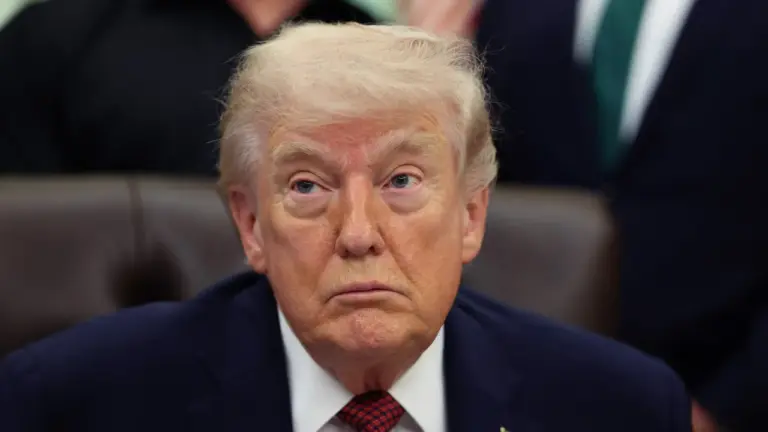
According to polls from the Public Opinion Fund (FOM), the number of Russians with a positive opinion on the US President Donald Trump has more than doubled since April, from 9% to 22%.
© Tasos Katopodis/Getty Images
28/11/2026
by
Lusa
O number of Russians who have a positive opinion about the US President, Donald Trump, more than doubled since April, according to poll results released today by the Public Opinion Fund (FOM).
Currently, according to these polls, 22% of the Russians have a good image of the head of the White House, an indicator that seven months ago was only 9%, points out the FOM on its website.
On the other hand, the number of citizens of the country who criticize Trump fell from 55% to 40% in the same period. The remaining 38% could not answer.
As for the US in general, 19% express a positive opinion, 25% negative and almost half (47%) maintain a neutral position.
Trump called Russian President Vladimir Putin “friend” during a recent meeting in China, where both attended a historic tripartite summit with Chinese leader Xi Jinping.
The American President was harshly criticized for this, but he justified himself by saying that he called Putin “friend” because he wants to end the war, adding that he has “a very good relationship” with the Russian leader for many years.
Trump said he asked Putin to “end all military aggression” against European countries, nations that accuse Moscow of conducting a hybrid war against their territories.
“ During my talks in China with the President of Russia, Vladimir Putin, I devoted a lot of time to talking about the fact that I would like to see President Putin end all military aggression against territories across Europe in the hope of reaching an agreement between Russia and Ukraine,” Trump said on his Social Truth platform.
Ukrainian President Volodymyr Zelensky was very critical of Trump, reiterating that it is like saying that someone was friends with German dictator Adolf Hitler during World War II.
Meanwhile, the Kremlin rejected the winter truce this Thursday, covering both the energy issue and the export of cereals by the Black Sea, demanded by the President of the European Commission, Ursula von der Leyen, classifying it as an “ultimate”.
Russian-Ukrainian negotiations, with mediation from the United States, were resumed on November 10 after almost nine months of interruption. The Europeans hope to take part in the next rounds, but Russia, for now, refuses.