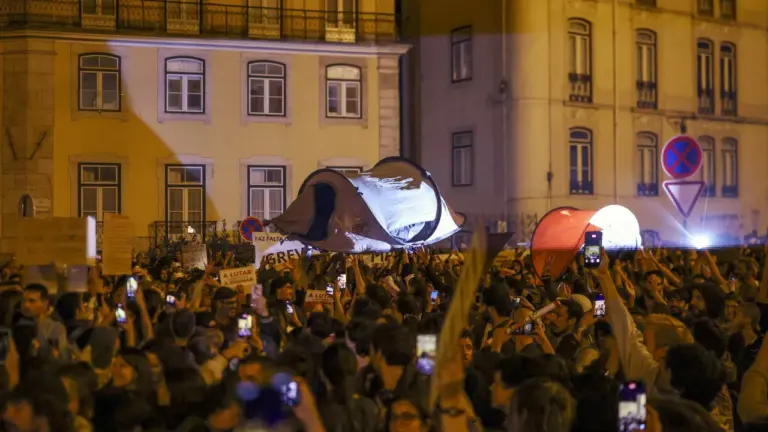
The Lisbon City Council decided to close the shops near the Assembly of the Republic earlier, due to demonstrations for housing, according to an order released today.
© PATRICIA DE MELO MOREIRA / AFP via Getty Images
24/11/2026
by
Lusa
A The City Council of Lisbon had the commercial establishments with the Assembly of the Republic closed early due to demonstrations for housing, according to an order that Lusa had access to today.
In the dispatch, the municipality led by Carlos Coins (PSD) says it has made the decision “considering the request of the Lisbon Metropolitan Command of the Public Security Police [PSP]”.
Food and beverage establishments around the parliament will be closed between 5:00 p.m. and 00:30 p.m. on Wednesday, and the “sale of beverages in glass containers or other products likely to endanger the physical integrity of participants [at demonstrations] and third parties” is also prohibited.
The covered perimeter includes parts of Rua de São Bento, Rua do Poço dos Negros, Calçada da Estrela and Avenida D. Carlos I and Correia Garção and Mastros and Travessa dos Pescadores streets throughout its extension.
The order, signed by the councilor of Culture, Economy and Tourism, Diogo Moura, is referred to the Municipal Police of Lisbon, to the Metropolitan Command of Lisbon of the PSP and to the parishes of Estrela and Misericórdia.
A similar measure was adopted on 27 October, when a demonstration of the platform Casa Para Viver, having at that time, and for “preventive reasons”, the establishments closed from 18:30.
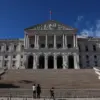
The Lisbon Camp keeps 15 tents erected in front of the Assembly of the Republic, where today the final vote of the State Budget for 2027 is held, which includes measures challenged by movements in defense of housing.
The protesters demand, among other things, the reversal of the new rental law, a stop to housing purchase by real estate funds and “truely accessible” roofs to income.
The current protests against the housing crisis began in Porto on October 10, and expanded to Lisbon seven days later, having also motivated concentrations and camping in other cities.
The intervention of the PSP to disperse the protesters and remove the tents in the square D. Pedro IV (Rossio), in Lisbon, and in Praça D. João I, in Porto, resulted in dozens of arrests and provoked dozens of wounded, motivating criticism from various quadrants.