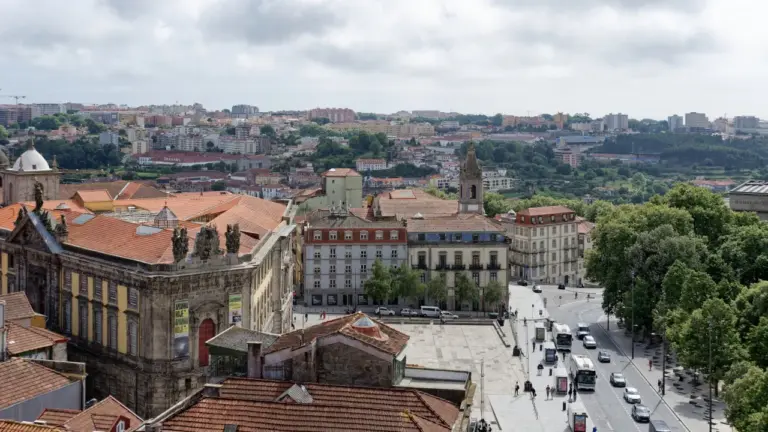
MUBi considers that the Porto mobility plan lacks robust measures to deter the car and ambition to calm traffic and encourage active modes.
© Wikimedia Commons/Jakub Hałun
29/11/2026
by
Lusa
A Association for Urban Mobility in Bicycle (MUBi) today considered that “there are no robust measures to deter the use of the car” in the port mobility plan, as well as “ambition and resources” for calming traffic and active modes.
According to a statement sent to Lusa, MUBi acknowledges the “free diagnosis” of the Sustainable Urban Mobility Plan (SMP) – whose public consultation ended on November 4 – but “considers that it lacks robust measures to deter the use of the car, as well as ambition and resources for calming traffic and encouraging active modes”.
“ Two thirds of the new ‘cyclable network’ only arrives after 2031, the goal for the bicycle is half of the national goal and only 2.2% of the investment is intended for this way’, states in the statement, detailing that the current network identified “consists of about 31 kilometres, of which only 12.5 kilometres are on a physically protected road from car traffic”.
The association points out that the PMUS “leaves 66% of the new network proposed for the second half of the implementation period of the plan (2032–2036), already after the end of the current municipal mandate”, and proposes “to complete it by 2030, building around 18 kilometers per year”.
“For the MUBi, the network can reach 68 kilometers already in 2028, more than the PMUS foresees for 2031”, suggesting for this three measures: “anticipate the shared roads, streets of little traffic where bicycles and cars circulate together at 30 km/h or less, with calm traffic and marking on the pavement”, “implement the road of the Junqueiro War Street, taking advantage of the already budgeted requalification”, and “create about 11 kilometers of provisional bike paths, marked on the pavement and protected by separators, without construction works”.
The association recalls that the mayor of Porto, Pedro Duarte (PSD/CDS-PP/IL) said, at the time of the public presentation of the plan, in July, that the municipality would “anticipate many of the deadlines” as to the cycling network, but MUBI says that the PMUS “does not reflect it”, asking for this definition “with dates”.
It also wants it to be established that instead of the 5% in 2035 foreseen in the PMUS, there will be 10% of bicycle rides by 2030, as set out in the National Strategy for Cyclable Active Mobility, and even if the PMUS has 20% of the budget for active mobility, “with at least EUR 30 per inhabitant per year for the bicycle, instead of about EUR 11 proposed”.
The MUBi warns that with the current design of the plan “almost half of the schools, kindergartens and day care centers in Porto (46%) will continue in 2036 to more than 200 meters from the bike lane network”, therefore proposes “that the 11 school streets provided for in the plan be completed by 2028 (closed to car traffic) and then extended to all schools”, including “parking for bicycles in the 74 public schools by 2028”.
It also wants the speed limit of 30 km/h “as a rule of the city from 2027 (...) with 50 km/h as an exception only in the structuring network”, which “means to have 74% of the city’s road network with a limit of 30 km/h, when the PMUS predicts only 21% in 2036”.
It also suggests a system of shared bicycles “with at least the same density as the GIRA system in Lisbon, planned in conjunction with neighbouring municipalities” and integrated in the Pass Andante, “compulsory parking for bicycles in new buildings and large renovations (at least two places per housing fraction)”, “measures of disincentive to the car and reduction of parking on the street” and the “despite the extension of the tunnels of Campo Alegre and Faria Guimarães”.
MUBi recalls that, according to the diagnosis, “Oporto is the Portuguese city with the greatest potential for the use of the bicycle”, so “with political will, a calendar and an investment at the time, this may be the decade in which the bicycle conquers the place that deserves as a viable alternative to the use of the automobile”.