The Ferreira do Zêzere Municipal Assembly unanimously approved the delimitation of the Dornes ARU, the object of a strategic plan to value the locality, which the municipality admits to apply for UNESCO.
© Shutterstock
28/11/2026
by
Lusa
A Ferreira do Zêzere Municipal Assembly today unanimously approved the delimitation of the Urban Rehabilitation Area (ARU) of Dornes, the object of a strategic municipal plan to value the locality, which the municipality admits to apply for UNESCO.
“ It is already an ambition, I would say a dream ", said to the agency Lusa the mayor, Bruno Gomes (PS), about a possible candidacy of Dornes the World Heritage, noting that "there is much to do" until this decision is made.
The proposal, unanimously approved by the municipal executive on Monday and today by the Municipality of Ferreira do Zêzere, in the district of Santarém, establishes an area of intervention of 11.3 hectares, constituting the second ARU of the municipality, after the one created at the headquarters of the municipality.
The delimitation covers the historical core, the riverfront and the areas of access to the locality, aiming to recover the built heritage, qualify public spaces, improve the conditions of habitability and fix population.
According to the document approved, the urban algorithm under analysis was in 2021, at the time of the Censuses, 23 inhabitants distributed by 10 households, with only 23% of the 44 habitual residences and the remaining secondary or vacant residences.
About 73% of the buildings were built before 1980 and more than half (26) had repair needs.
Owners may benefit, by complying with the legal requirements, from exemptions from IMI and IMT, deductions from IRS and application of the reduced VAT rate of 6% in certain rehabilitation undertakings.
The House also concluded a protocol with the University of Coimbra for the development of a strategic plan (masterplan) that includes urban rehabilitation, tourism enhancement, nature conservation and requalification of the surrounding area.
“We want, above all, to work on a ‘masterplan’, to understand what are the great added value at all levels, but in a very technical and scientific way,” Bruno Gomes explained, referring to a later stage of evaluation of a possible UNESCO application.
Among the municipal priorities are the creation of parking, the requalification of public spaces and the completion, during the current mandate, of the intervention in the pentagonal tower and the museological space, awaiting an opinion from the entity responsible for the heritage to continue the works.
The demarcation of the ARU is also aimed at facilitating access to Community funds, and the mayor referred to an application for financing work carried out under a EUR 300,000 project, the warning of which required the creation of that urban instrument.
In the Municipal Assembly, the elect of PSD Eduardo Mendes defended the recovery of the built heritage and the need to encourage the owners to rehabilitate the properties, contributing to the revitalization of the locality.
Bruno Gomes also announced that Avecasta will be the next locality to benefit from an ARU, highlighting the preservation of stone dwellings and the importance of investment in the Grotto of Avecasta and the continuity of archaeological work.
The municipality subsequently intends to extend this instrument to the headquarters of parishes or to locations with higher housing concentration.
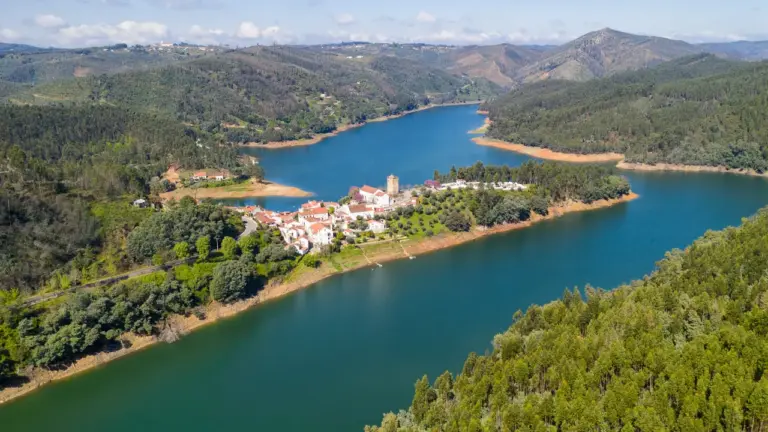
Situated on a peninsula bathed by the albufeira of Castelo do Bode, Dornes received foral of D. Manuel I in 1513, it was county seat until 1836 and was elected, in 2017, one of the Seven Wonders of Portugal, in the category of Villages Ribeirinhas.
The pentagonal tower, of medieval origin and associated with the presence of the Templars, and the church of Nossa Senhora do Pranto are classified as properties of public interest since 1943.
The delimitation of the ARU will be published in Diário da República, following the preparation of the Urban Rehabilitation Operation (ORU), which will define the strategic intervention program.