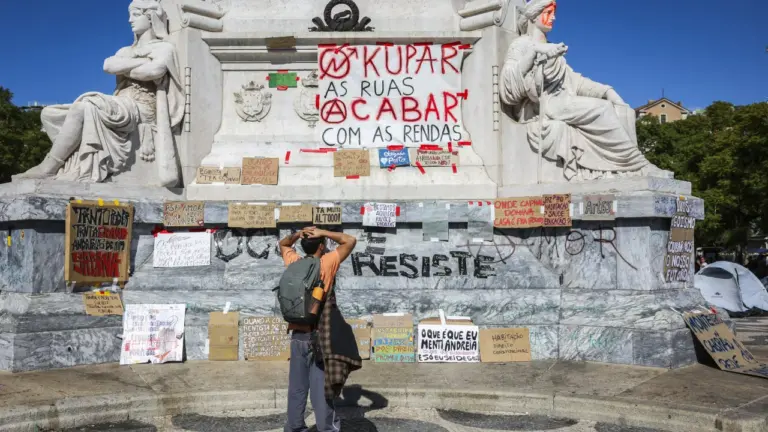
The tax will be able in 2027 to collect debts to those who vandalize monuments with “graffitis” or other forms of damage to the estate, if the author does not pay the repair costs, according to a proposal approved in parliament.
© Lusa
23/11/2026
by
Lusa
O tax will be able in 2027 to collect debts to anyone vandalizing monuments with 'graffitis' or other forms of damage to the heritage, if the author does not pay the repair costs, according to a proposal approved in parliament.
The new rules are called “exclusive system for charging charges for monuments” and are the result of a proposal to amend the State Budget for 2027 (OE2027) submitted by the PSD and CDS-PP.
The initiative was approved by the Aquira, IL and the parties supporting the Government, having received the votes against the PS, PCP, Livre, PAN and BE.
The initiative adds a new standard to a law already in force that regulates the regime of sanctions on graffiti, postings, pictographing and other forms of change in the original characteristics of exterior surfaces of buildings, floors, walks, walls and other infrastructures.
The current legislation already states that the authors of changes in appearance that cause damage must bear the burden of removal and or repair and, with the addition of the new standards, there will be a specific regime for those who do so in relation to “movies classified in the monument category”.
With this initiative, the PSD and the CDS-PP create a coercive debt recovery regime for those who are obliged “to bear the necessary and appropriate charges for the removal, cleaning, preservation, repair or restoration of the monument” and do not.
The Tax and Customs Authority (AT) may be called upon to proceed with a tax execution procedure at the request of the injured entity which carries out public removal and or repair services (e.g. a municipal chamber).
The legislation of the parties that support the Government in parliament provides that the injured entity “notifies the author responsible for the damage in property classified as a monument to, within 30 days, pay the costs of removing the damage caused in the monument”.
In the “lack of payment”, the entity issues a debt certificate “in order to be enforceable, complying with the requirements of Article 163 of the Code of Procedure and Tax Procedure”, to, wanting, request that the debt be collected in execution process by the tax.
Although the legislative text does not expressly state that the entity responsible for coercive recovery is the OA, this task is directly derived from rules of the Code of Procedure and Tax Procedure (CPPT) , since the drafting of the OE does not indicate who is responsible for opening the execution and Article 150 of that code puts the tax as the person responsible for it first.
Article 150 of the CPPT provides that the tax administration is the service “competent for tax execution”, and it is up to it to establish the execution and practice the execution acts to ensure the recovery of the debt.
The legislative wording of the PSD and CDS-PP expressly states that these rules apply “exclusively to buildings classified in the monument category, regardless of the entity responsible for its ownership, administration, management, conservation or maintenance, and are not extendable, for the purposes of the special scheme provided herein, to buildings, equipment, infrastructure or other goods that do not review that category”.
It is also ensured that the rules apply ‘without prejudice to the criminal or counter-national liability to which there is a place’.
In the justification of the initiative, the Social-Democratic and Christian Democratic benches state that the measure enshrines “the principle of the ‘destructor-payer’ in relation to the unauthorized execution of graphs, inscriptions, pictograms or other forms of change in the appearance of monuments” and underlines that “if the injured entity wishes, it is possible, after issuing the debt certificate, to request that it be charged in the process of tax execution”.
When the initiative was presented by the two parties on November 6, journalists questioned the parliamentary leaders of the PSD and the CDS about whether this measure arose due to recent demonstrations for the right to access to housing in Lisbon and Porto.
PSD parliamentary leader Hugo Soares replied: “It is clearly not important to know whether the measure was born yesterday or last week. The question is whether the measure is fair or not. We feel the need to include this measure because it is just.”.