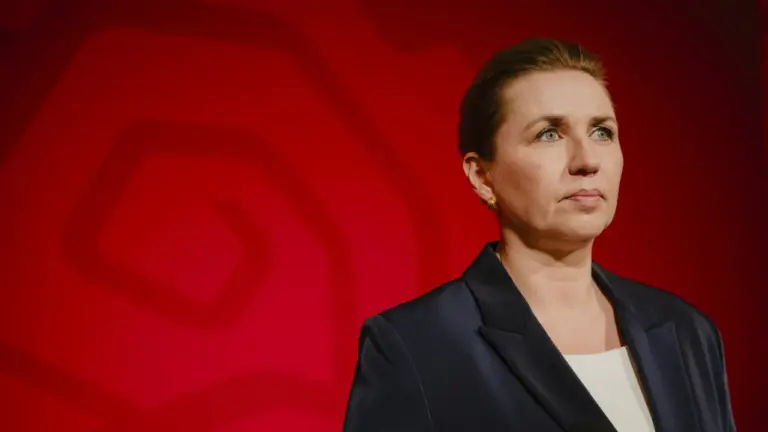
The Danish Social Democratic Prime Minister, Mette Frederiksen, today rejected any association with the far right, a week after using the term “great replacement of the population” in an interview.
© Nichlas Pollier/Bloomberg via Getty Images
24/11/2026
by
Lusa
A danish Social Democratic Prime Minister Mette Frederiksen today rejected any association with the far right, a week after using the term “great replacement of the population” in an interview.
“I want to avoid being put in the same bag as conspiracy theorists, right-wing extremists or fascist movements, on which I have nothing positive to say,” Frederiksen wrote in a long publication on social networks.
“There is no harm in defending the country we love,” said the head of government.
On November 17, Frederiksen claimed not to be “partisan of a large population replacement.”.
“ We are a Danish society and we have a population of origin that is ethnically Danish,” Frederiksen added the day after presenting the project to create a European centre for migrants in Rwanda, which he has been defending for over six years.
The statements were welcomed by the Danish extreme right-wing movement Identitary Generation, but initially gave rise to little controversy in the Scandinavian country, where a restrictive immigration policy has a broad consensus.
The debate gained momentum today after the publication of an open letter from a survivor of the Utoya massacre in Norway 15 years ago.
“ I never thought I would hear a European leader, let alone a social democrat, use the vocabulary” of the [Norwegian terrorist] Anders Behring Breivik, wrote Tarjei Jensen Bech in the Danish daily Politik, referring to the neonazi extremist responsible for the attacks of 22 July 2011 in Norway.
“I don’t think you want to say the same thing as Breivik (...). The ‘great replacement of the population’ is not a neutral expression. It has a history and this story led to the death of young people in Utøya,” Bech added.
Asked by TV2 television station, Danish Deputy Prime Minister and leader of the Socialist People's Party, Pia Olsen Dyhr, said that she would not use that expression because it was not part of the foundations of her policy.