
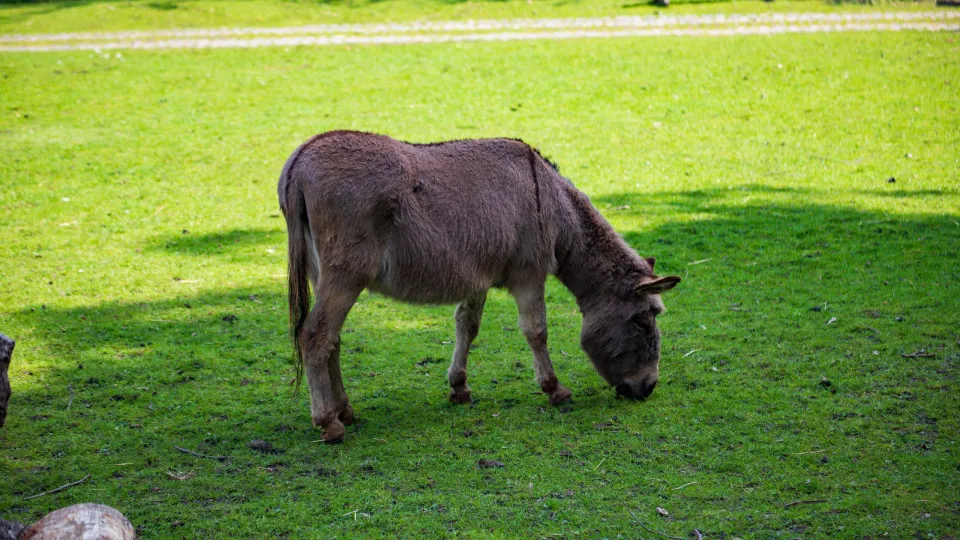
Twelve donkeys from Miranda start cleaning up rural land in an area of 30 hectares near the substation of Lagoaça, in Freixo de Espada à Cinta, revealed REN – National Energy Networks.
© Shutterstock
10/11/2026
by
Lusa
Doze burros de Miranda from today to clean up rural land in an area of 30 hectares near the substation of Lagoaça, in Freixo de Espada à Cinta, today revealed the REN - National Energy Networks.
In statements to the agency Lusa, the representative of REN Pedro Marques said that one of the objectives of this action, which uses a sapper animal brigade composed of 12 mirandese donkeys, is to manage fuel to prevent rural fires, as well as promote greater resilience to fire in an area of 30 hectares of land, next to the electric substation of Lagoaça, located in the Douro International Natural Park (PNDI).
“ These animals as they feed are lowering the existing fuel load and, based on that, our infrastructure is more resilient to rural fires. These animals will also contribute to soil fertility, reflecting biodiversity. At the same time, we are valuing an autochthonous species ", indicated the responsible for the Sustainable Network and Services area of REN.
This project results from a partnership between REN and the Association for the Study and Protection of Asinino Cattle (AEPGA), in the district of Bragança, scheduled for five years.
According to the responsible, this action promotes the removal of all the lower vegetation.
“ Usually this work is done with machines such as tractors or motors. Here we apply a natural-based solution that helps to resolve a situation that REN has to comply with,” said Pedro Marques.
To Lusa, the technical secretary of AEPGA, Miguel Nóvoa, explained that each donkey is able to eat 20 to 30 kilos of biomass per day and travel 12 kilometers per day, promoting changes in the landscape.
“ These animals, through the rotational grazing, reduce the fuel load for a month in a portion of five hectares, and then move to other points, preventing the vegetation from growing again,” he said.
The area covered by the project brings together several habitats where wetlands, meadows and pastures coexist, mountain range, fauna and flora. In wetlands, the presence of animals helps to maintain the physical characteristics that allow temporary accumulation of water and support the fauna dependent on these environments.
In the meadows and pastures, the rotating grazing carried out by the donkeys of Miranda helps to control the growth of vegetation and preserve the diversity and balance of the ecosystem.
On the other hand, the animals contribute to the management of the vegetation in the mountain range.
The project, over the five years expected to last, also includes impact studies, biodiversity monitoring and evaluation of the efficiency of adopted solutions and good practices, enabling information to be collected to identify replication opportunities elsewhere in the country.
Animals are controlled by GPS systems and electrical seals, and there will be water spots for animal welfare.
On the side of the Nature Conservation Institute, responsible for the North region, Sandra Sarmento, said it is an “interesting, positive” initiative, because it transforms an obligation of REN to create fuel management bands and at the same time support an autochthonous race as is the Burro de Miranda.