
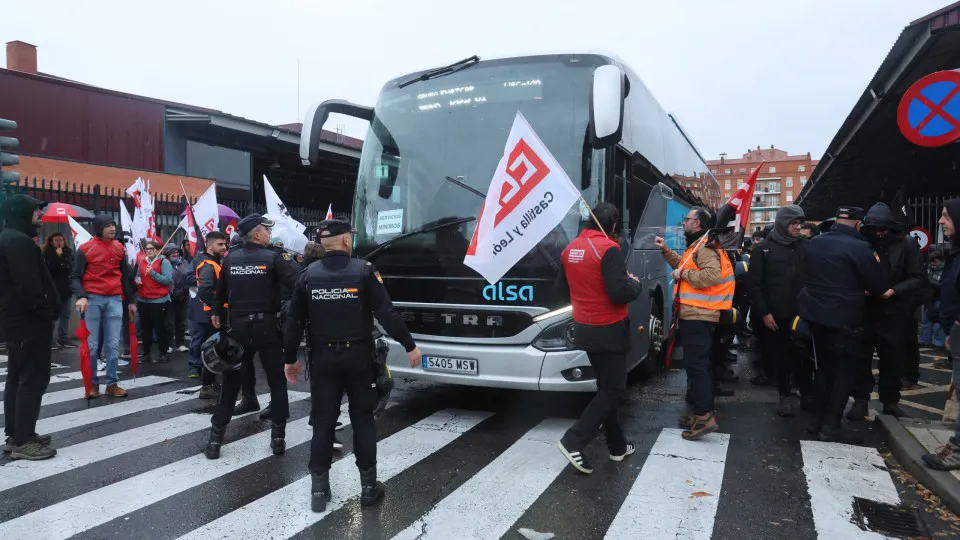
Today’s general strike in Spain, called to claim “housing and decent wages”, started at midnight and had in the first hours accessions between 41% and 75%, according to the regions, according to the unions.
© Lusa
11/11/2026
by
Lusa
A today's general strike in Spain, called to claim "housing and decent wages", started at midnight and had in the first hours accessions between 41% and 75%, according to the regions, according to the unions.
The first hours of the general strike – the first in 14 years in Spain – and early in the morning were also marked by the cutting of access roads to large cities, such as Madrid and Barcelona, due to concentrations of people in protest.
In the region of Catalonia, the transit authorities recorded at the beginning of the morning about 60 roads cut by concentrations, including several accesses to Barcelona.
In Madrid, the mergers even cut off two motorways of access to the capital for some time.
As far as public transport is concerned, minimum train and metro services have been set up, which are generally being complied with by the authorities.
In the case of the Madrid metro station, the company said that the network was operating above the minimum services and almost normal in the first hours of the day.
The unions denounced police charges on strike pickets in factories, supply markets or other locations, with security forces justifying interventions because pickets were preventing access to workers who did not want to join the shutdown.
According to the two major Spanish trade unions (CCOO and UGT), global adherence to the strike oscillated, in the first round of the day (that of the night), among the 41% in autonomous regions such as Extremadura or Castile-La Mancha and the 75% in Andalusia and Aragon.
In Andalusia, adherence to the strike has kept cut, since midnight, leading to the cut of the emission of autonomous public television (Canal Sur).
The unions say there was a 10% reduction in usual energy consumption by 7:00 a.m.
This is the first general strike called in 14 years in Spain and was marked and takes place in the early legislative campaign of 29 November.
The 24-hour strike was called just after the early national elections by the Prime Minister, the Socialist Pedro Sánchez, and the trade union centres themselves qualify it as “atypical”.
In addition to joining the strike, the unions called for demonstrations to be mobilized in concentrations, such as the marches that are scheduled for the end of this afternoon in several cities, including one in central Madrid.
For the trade unions, the success of these 24 hours of protest will be mainly in adherence to the demonstrations and not so much in the impacts on the activity of companies and services in the country.
The call for the strike by the two major Spanish trade unions (CCOO and UGT) responded to an appeal from the associations gathered in the Confederation of Inquiries Unions, which defend the right to housing and have mobilized thousands of people in protests on the streets in Spain since 23 September.
Right-wing opposition parties and business associations criticized the call for an electoral strike, which they considered to have a “clear political component” and seem to target the opposition more than the left-wing government.
The government has defended the right to strike and insisting on respecting this “constitutional right”, with the public agenda of today’s ministers being almost empty and only predicting activity for two of them who are abroad.
The unions have stressed that the general strike was thought before the call for elections and that it has several recipients, including employers' associations, regional governments and the central executive.
The last general strike in Spain called by UGT and CCOO was in 2012.