
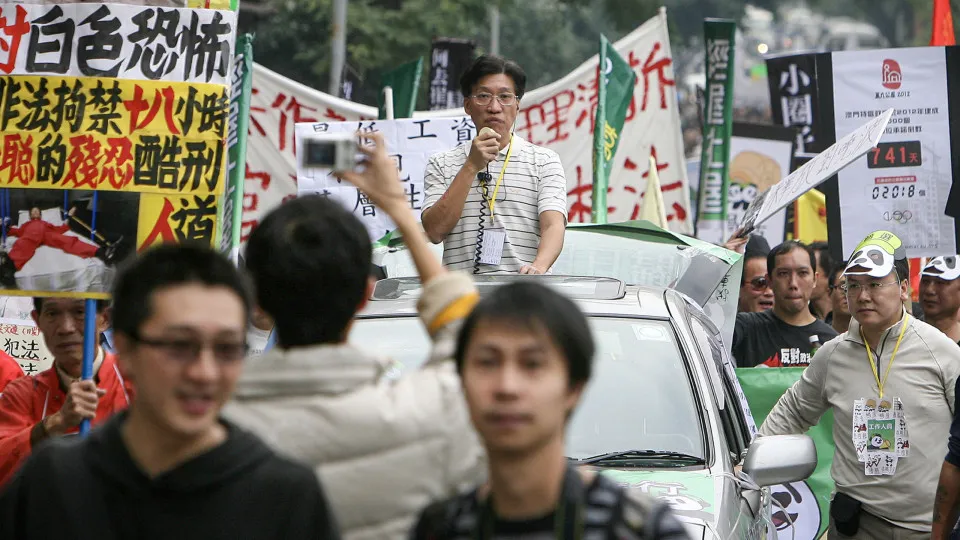
Human Rights Watch (HRW) today argued that the former deputy to the Macau parliament Au Kam San was convicted “on the basis of unfounded accusations” and called for the activist’s “immediate and unconditional” release.
© Lusa
10/11/2026
by
Lusa
A Human Rights Watch (HRW) today argued that the former deputy to the Macau parliament Au Kam San was convicted “on the basis of unfounded accusations” and called for the activist’s “immediate and unconditional” release.
The Court of Justice has condemned On Friday he was sentenced to 12 years and six months in prison, in the first case under the State Security Defense Act since the creation of the Macao Special Administrative Region (RAEM).
The conviction was “on the basis of unfounded accusations related to national security,” HRW advanced in a statement, arguing that “the Macau government must cancel the sentence and release Au immediately and unconditionally.”.
“ The unfounded accusation of Macau authorities against former deputy Au Kam San reflects Beijing’s growing repression in all its territories,” HRW’s deputy director Maya Wang said in the text.
“The sentence, which can keep the defender of democracy in prison until he is more than 80 years old, is both scandalous and cruel,” says the activist.
The non-governmental human rights organisation specifies that the court did not disclose the judgment in full, but only a summary of its decision, and adds that “the case against Au involved serious violations of its right to a fair trial”.
HRW describes Au, Portuguese citizen and former teacher of basic education, “one of the pro-democracy legislators with the most time in service in Macao,” “elected directly to the Legislative Assembly between 2001 and 2021,” as “one of the few consistent voices to defend democratic reform, government accountability and social causes.”.
“ For 15 years, he campaigned in favour of free public education and more social housing, monitored public expenditure and expressed concern about corruption and misuse of public funds,” and, after leaving the parliament, “he continued engaged in public affairs, including efforts to protect the historic Guide Lighthouse in Macau,” the statement describes.
HRW also considers that Au “has also played an important role” in Macau’s civil society, notably as “the leader of the Macau Union Group for Democratic Development”, which “organised annual vigils in memory of the 1989 Tiananmen Square Massacre in Beijing, even when he and his fellow organizers were abused because of their efforts, including physical assaults and loss of employment”.
“The Macau government has long suppressed critical voices,” says HRW.
“Portugal, the European Union and other governments involved must press public and vehemently for the immediate and unconditional release of Au Kam San,” defends Maya Wang.
“ Countries should take note of recent severe sentences in Hong Kong and Macao and consider what this means for their long-term relations with the Chinese government,” HRW concludes.
The Portuguese Ministry of Foreign Affairs announced on Saturday that it had transmitted to the Chinese authorities a position of “repudio and of serious concern” with the condemnation of Portuguese citizen Au Kam San.
On the same day, the EU also “deplored” the condemnation and sentence of Au by means of a statement from the European External Action Service (EEAS), in which it considered that it “confirms the erosion of political pluralism and freedom of expression” in Macao and regrets that “public, press and diplomat access” to the activist’s trial was “restricted”.
The Macau Government challenged the various international reactions to the case, expressing “indignation and strong opposition to unfounded statements” by entities such as the EEAS, the Executive Board of the United States Congress on China, the United Nations High Commissioner for Human Rights and some Members of the European Parliament.
The Executive of the territory maintained that “the judicial independence” of Macau “is closely guaranteed by the Basic Law, and [that] the Government of the SARS respects and supports the judicial authorities in the independent trial of cases according to the law”.
In turn, the Hong Kong and Macao Office for Affairs of the Chinese Council of State stated that “hostile external forces” tried to “dicate the course of events and openly interfered” in the case of Au Kam San’s trial, considering these attempts as proof that “anti-China and anti-Macau elements, as well as hostile external forces, never abandoned their plans for destabilization of the region.”.
“ Through several alleged reports and legislative proposals, they manufacture and disclose false narratives, despise the rule of law and human rights in Macau, and distort or defame the practice of ‘one country, two systems’,” the Chinese government office accused.