
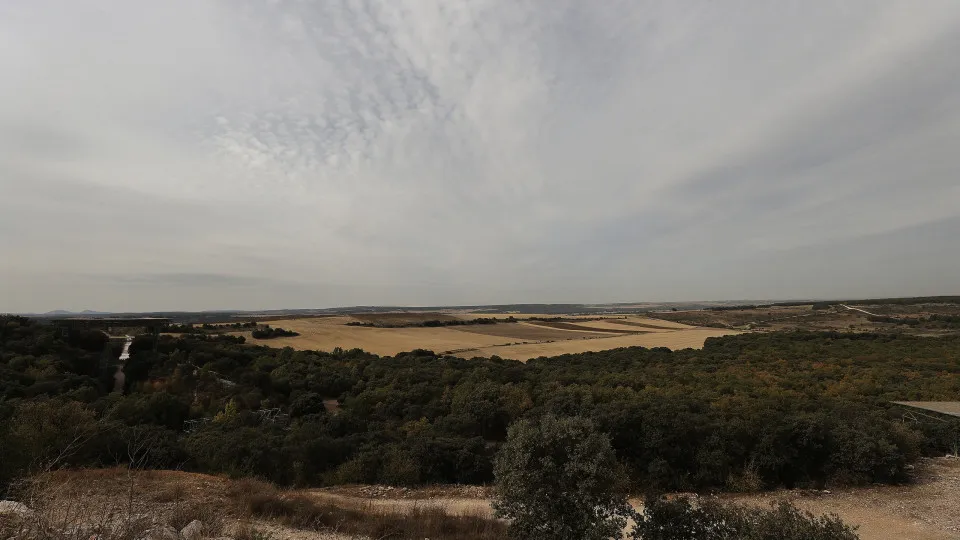
Researchers in Burgos study the transition from the Celtic city of Klounioq to the Roman city of Clunia with new discoveries about the evolution of the region
© Burak Akbulut/Anadolu Agency via Getty Images
11/11/2026
by
Lusa
Iinvestigaters are dedicated in the spanish region of Burgos, for three years, to excavations to clarify how the transition of the celtibera city of Klounioq, which emerged in the fourth century BC, to the Roman city of Clunia, nearby.
The director of the investigation, Luis Valdés, explained in a press conference that the current hypothesis is that Roman troops could not subjugate Klounioq.
The city, according to investigations, was not conquered, but progressively emptied, perhaps due to the attraction exerted by the rich surrounding Roman city.
In this summer's excavation campaign, it was discovered in Klounioq, in the municipality of Quintanarraya, a foundry area of the 2nd century B.C., in addition to the remains of an arevac defensive tower, a unique example in Castile and Leo.
Due to its monumental dimensions, the refined constructive technique and the materials used, this building, whose investigations will continue in the summer campaign, represents a unique case in the polyorcetics (art of besieging or defending cities) of Arevaca, with no similar parallels in Castile and León.
“ It does not appear that the tower, which had a base of five by five meters and an estimated height between five and eight meters, was destroyed in an attack. On the contrary, over the centuries, its stones have been removed for other purposes: from the construction of houses to their fragmentation to serve as a basis for paths,” Valdés reported.
The archaeological campaign of 2026 also revealed an artisanal area specializing in iron and copper, dating from the 2nd century BC, possibly the largest ever found in the Iberian Peninsula.
It is the remains of two reduction furnaces and a workshop whose pavement was paved with limestone, pebbles, slag fragments and ceramics, aiming at the prevention of fires.
In this area, iron ore was fused, copper was processed and bronze produced.
In addition, manufactured objects were equipped with cables made from cervid stems, of which several specimens were found in a precarious state of conservation.
Carbon-14 analysis, performed by a laboratory in Florida (USA) on coal samples, places the workshop activity between the second third of the 2nd century B.C. and the 1st century B.C.
Among the ceramic remains, there is a pipe, a piece molded by hand and around, of rare occurrence, used to channel the air from the bellows to the inside of the oven.
A knife, various metal tools, needles, plates, wires and splatters were also found, as well as about thirty articles made from cervid stems from the handles of utensils and tools.