
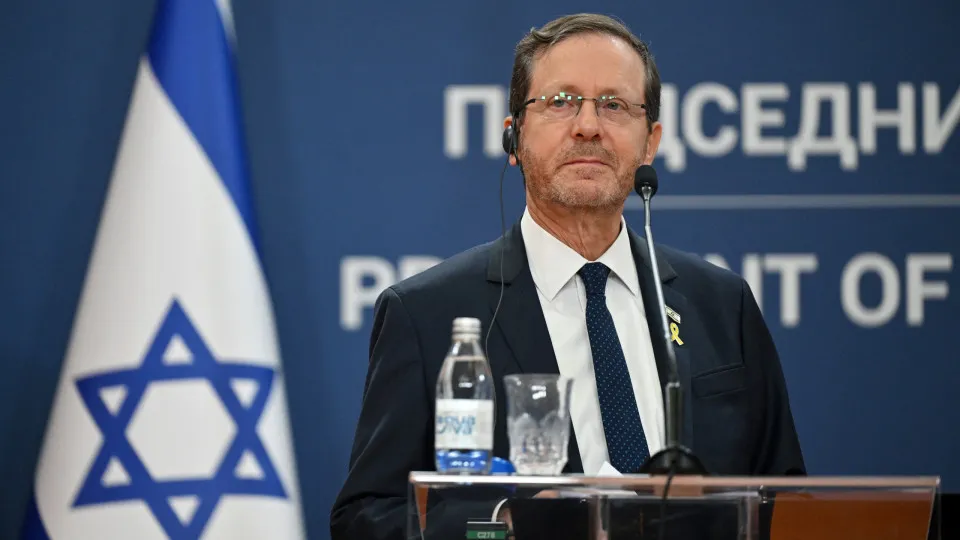
Israeli President Isaac Herzog today asked the parties to make concessions and reach a consensus to form a new government during the inaugural session of the new Parliament (Knesset) after the legislative elections that resulted in a political stalemate.
© OLIVE BUNIC/AFP via Getty Images
10/11/2026
by
Lusa
O Israeli President Isaac Herzog today urged the parties to make concessions and reach a consensus for a new government during the inaugural session of the new Parliament (Knesset) after the legislative elections that resulted in a political stalemate.
“ Extend your hand to concessions, including your rivals,” said Herzog, after beating the hammer three times to start taking possession of the 26th Knesset.
The Israeli President stressed that the new 120 Members were elected by a people who “want routine, security and tranquility” and, in this sense, wants to see them “transform these qualities into cooperation, unifying dialogue and active listening”.
In his speech, Herzog noted that nearly 77% of Israeli voters voted on October 27 and this participation means that the new parliament has a responsibility to complete its mandate.
“They must do everything they can to avoid a second election round,” he warned 120 Members about the risk of a new vote if no agreement is reached to make a government viable.
The Israeli President also said that, in addition to fighting those who seek “evil” against Israel, specifically mentioning Iran, the alliance with the United States should be strengthened and agreements with Egypt, Jordan, Morocco, the United Arab Emirates and Bahrain should be strengthened and even extended.
Herzog condemned racism, harassment and violence in Israeli society, alluding to the Arab and West Bank community in the context of ongoing attacks by Israeli settlers on Palestinians, journalists and activists.
“ Israeli society is magnificent, extraordinary. But unfortunately, there are moral stains that stain your beautiful face. There is no room for intimidation”, he warned, adding that “this violence must be eradicated with all forces”.
The Head of State also called for an investigation into the attacks led by the Islamist Hamas group on October 7, 2023, when the opposition demanded an independent commission of inquiry, so far refused by the outgoing Prime Minister, Benjamin Netanyahu.
In the same way, he defended the distribution of military service obligations among the different sectors of society, referring to the debate on the exemption of ultra-orthodox Jews, a red line for the two political forces representing them and holding 13 seats in the new Knesset.
Parliament reflects the division that came out of the legislature, in which neither the bloc of support for the outgoing executive, the Likud party and Benjamin Netanyahu, nor the so-called bloc of change, led by Yashar! and the former head of the Gadi Eisenkot armed forces, achieved an absolute majority to enable a government.
Indicated on Sunday by Herzog to form an executive, Eisenkot today, on his arrival in the parliament in Jerusalem, undertook to do so “as soon as possible”, insisting on the need for “a national emergency government that takes Netanyahu away from power”.
The four Jewish opposition-based parties managed to elect 48 deputies and fell short of the 61 majority to control the Knesset.
The two Arab forces obtained a record result of 19 deputies and endorsed Eisenkot to form government, but their support is rejected by one of the parties in the bloc of change, the Yisrael Beytenu (Israel is Our House), of the former Minister of Right-wing Defense Avigdor Lierberman.
The key to the future government may be the 13 representatives of the ultra-Orthodox parties, who supported Netanyahu in the previous political cycle, or a majority who group various sensitivities, including Likud's elected parties.
Before the inaugural session, Eisenkot reached agreement with the other opposition parties to obtain a majority of 61 votes and appoint the former Minister of Religious Affairs and Mr Matan Kahana, who was in fifth place on the Yashar list!, as the next president of the Israeli parliament, in place of Amir Ohana of the Likud.
The four Zionist opposition parties also agreed, according to a joint communiqué, to appoint Lieberman to head the strategic parliamentary committee on Foreign Affairs and Defence.
Newcomer Liran Warn Ben Horin, elected by the coalition Together, of former Prime Ministers Naphtali Bennett and Yair Lapid, will be appointed to the Finance Committee, in accordance with the statement.
The new president of parliament was elected deputy in 2019 on a right-wing list led by Bennett, who called him to the short-lived government (2021-2022) shared with centrist Yair Lapid, the name most pointed to lead the new Knesset.
The choice eventually fell into a name of Yashar! and in Matan Kahana, who, before joining Eisenkot in 2025, still militated in the Blue and White Party, of another former head of the armed forces, Benny Gantz, who in turn came to present himself to the latest legislatures, but gave up a few days before the vote.
Netanyahu has demanded the leadership of a future “government of national unity”, as leader of the Likud, which was the most voted party, with 27 deputies, six more than Yashar!.
But his support base was shorter when the ultra-orthodox of the United Judaism of the Torah took away his support from his seven deputies, who, however, did not endorse Eisenkot in consultations with the parties held last week by Isaac Herzog.
In the end, Yashar's leader! received the support of a total of 67 deputies, including Arab forces, against 46 of Netanyahu.
Eiskot has 28 days, counting since Sunday, to present a viable government solution in parliament, extended for another 14.
If not successful, the decision returns to Herzog, which will indicate another candidate and the count is back to zero for another 28 days, without possibility of extension.