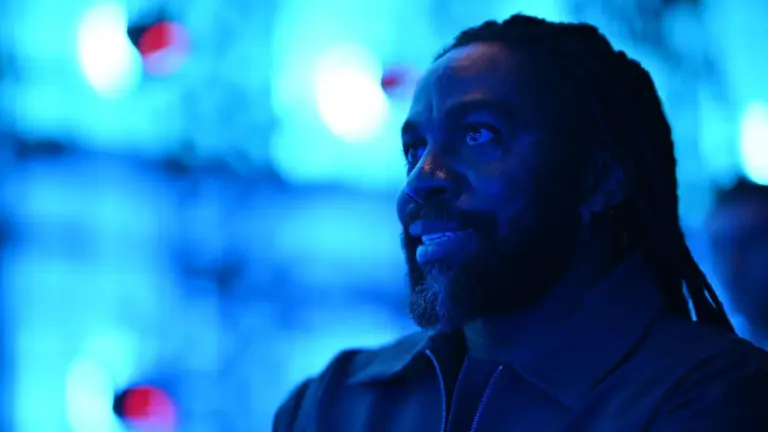
Brazilian actor and writer Lázaro Ramos warned today about the influence of great technology on political choices and democracy, defending the need to fight extremes and regain dialogue to build a collective project of society.
© Sam Barnes/Web Summit via Sportsfile via Getty Images
22/11/2026
by
Lusa
O brazilian actor and writer Lázaro Ramos warned today about the influence of great technology on political choices and democracy, defending the need to combat extremeisms and recover the dialogue to build a collective project of society.
“ How will we manage to have an ethical system to maintain democracy that is not above the values and the conduct of these ‘big techs’?”, questioned the artist during a conversation at the Utopia Festival in Braga, where he spoke of his personal and professional career, racism, Brazilian politics and the importance of literature.
For Lazarus Ramos, the power of digital platforms and their algorithms on the circulation of information is one of the main challenges of contemporary societies, as they are influencing collective thinking and political decisions.
“ We cannot forget that collective thinking, that political choices, are being influenced by ‘big techs’, he said, recalling that, if the concentration of brazilian media in the hands of some families was previously criticized, today the influence of large technological companies raises new questions.
“It is a very serious problem, which I, for example, do not know what the solution is,” he acknowledged during a “life interview” session.
Asked about the persistence of political support for Jair Bolsonaro in Brazil, the actor considered that polarization has deep roots, including the resistance of sectors of society to social transformations and the conquest of space by historically excluded groups.
But he also pointed out responsibilities to progressive sectors, which, in his opinion, have moved away from a part of the population, particularly from people who have found in religious communities spaces for reception and recognition.
“A part of progressism has gone away. It is important to assume this, because it also tires to be in a fight all the time”, he said.
Lazarus Ramos also criticized the use of lies and violence in political confrontation and rejected the idea that complex problems, such as crime in Brazil, can be solved through simple solutions.
“ There's no way to solve a complex problem with an easy solution. The problem of violence in Brazil is difficult to solve,” he stressed.
Regarding violence in Rio de Janeiro, Lázaro Ramos recalled that the state has long been governed by the right, “and has not solved the problem of violence.”.
“ And people are thinking they're gonna solve the problem of violence with an extreme right. That's a lie. It won't. That's a lot of throat. That's a lot of talk. It's too gogo. There's no way to solve a complex problem with an easy solution. The problem of violence in Brazil is difficult to solve,” he stressed.
However, assuming that he is progressive, he argued that this political identity should not prevent dialogue with those who think differently.
“ Because I'm progressive, it doesn't mean I'm part of a cult. I am not part of a sect ", said the actor, for whom it is fundamental to recover the historical memory, learn from the mistakes of the past and find new forms of coexistence.
“ I don't believe in antiprojects. I believe in projects,” he said, criticizing Brazilian political debates, describing them as “fifth-grade talk”, marked by mutual accusations instead of presenting proposals.
Political reflection was also linked to the experience of Lázaro Ramos as a black actor and anti-racist activist, a condition he claimed not to have chosen voluntarily, but that was imposed on him by the inequalities he encountered throughout his career.
“ I never chose to talk so much about racism, I didn't choose to be an activist. This was a summons from my existence in the world ", confessed.
The artist recalled situations of professional discrimination, including pay differences in relation to colleagues with smaller roles, which led him to use public visibility to denounce injustices.
“ The thing I wanted most was not to have to talk about it. Because this is a leap in the life of the black person ", confessed.
“Just that racism goes down on us and we live in a shock,” he added, recognizing, however, that his public intervention has contributed to sensitize people and promote transformations.
Awareness of the importance of black representation began to form in adolescence, when he joined the Olodum Theatre Band in Salvador, Bahia, where he discovered the possibility of interpreting characters that did not reproduce stereotypes usually associated with black actors.
From a poor family, Lázaro Ramos said that he even considered leaving school and theatre for economic difficulties, but a teacher realized his discouragement and encouraged him to continue.
This experience helped him to understand the transforming power of words, which he also considers to be central in the literature.
Author of 11 books, the actor was at the Utopia Festival to present his writing, namely reflections on identity, racism, memory and belonging present in the works “In My Skin” and “In Our Skin”.
Regarding her mother, Celia Maria do Sacramento, she recalled the conditions of exploitation and violence she faced as a domestic worker.
The actor said that the mother lived in the house of the boss, of whom “picked up”, without days of rest, having come to witness an aggression of the employer.
Nevertheless, his mother sought to protect him from suffering, always receiving him with a smile: “All the violence she went through, she wouldn’t let them get to me.”.
The reconstruction of maternal history, through conversations with people who met her, allowed her to review an image she considered unfair and recognize the strength of a woman who died when he was only 17.
Lazarus Ramos explained that he seeks to use writing not only to denounce injustices, but also to point out ways and possibilities of transformation.
“ I can use this as a complaint, but I always try to point out ways, point solutions. This is my commitment to my art, to my communication ", said.
This concern is present at the end of “In Our Skin”, in which he imagines a society in 2053, after a period marked by crises, wars and extremisms.
“ We’re going to need to be more utopian, to think the unimaginable”, he defended.
The writer explained that he found in fiction the possibility of building a hopeful outcome for a book crossed by painful experiences and a critical view of society.