
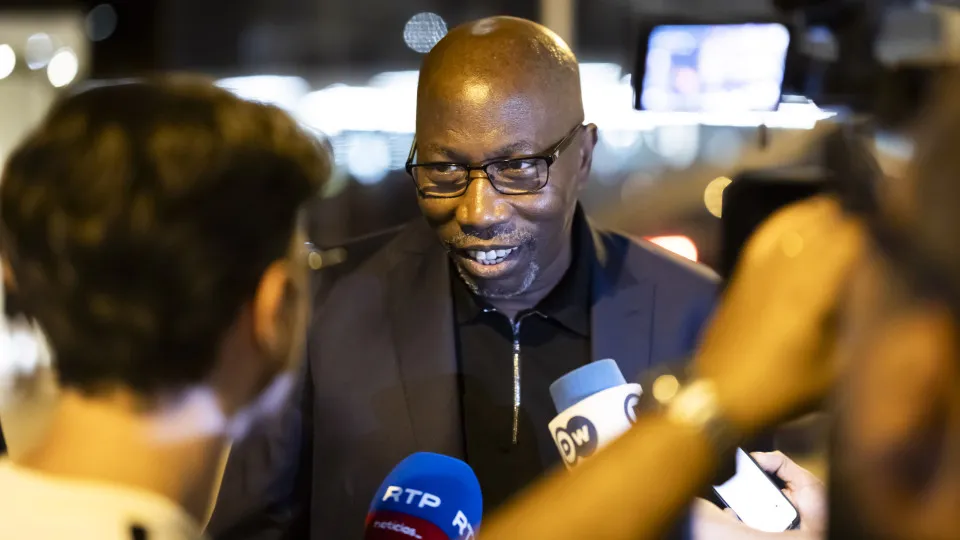
Guinean politician Domingos Simões Pereira argued that democracy in Africa is not limited to elections, even if free and fair, and highlighted the need for sound institutions and mechanisms for monitoring power.
© Lusa
12/11/2026
by
Lusa
O guinean politician Domingos Simões Pereira today argued that democracy in Africa cannot be limited to holding elections, even if free and fair, also requiring consolidated institutions and mechanisms for monitoring power between electoral acts.
“ The citizen cannot be sovereign only on the day he votes,” said Domingos Simões Pereira, at a conference on democracy in Africa at ISCTE – Lisbon University Institute, where he addressed the core ideas of his latest book, “Democracy in Africa”.
Simões Pereira has been in Portugal since July, after being released from prison in Guinea-Bissau, where he had been arrested by order of a military court, under a case related to an alleged attempted coup in October 2025.
The leader of the African Party of Independence of Guinea and Cape Verde (PAIGC) had been arrested following the coup d'état of 26 November 2025, which removed from power the then President Umaro Sissoco Embaló and interrupted the electoral process, the day before the planned release of presidential and legislative results. After more than two months in custody, he moved to a guarded residence before returning to prison in July.
In statements to Lusa on the margins of the event, the leader considered that one of the main obstacles to democratic construction in Guinea-Bissau is the fragility of the state, which, in his view, was proclaimed, but was not built.
“ One of the fundamental prerequisites for democratic construction is our biggest deficit, which is the question of state consolidation. Our state was proclaimed, it was not built ", he said.
For the leader of the PAIGC, it is necessary to recognise these weaknesses and find mechanisms to compensate for institutional imbalances.
“ We, our generation, feel some frustration because we see time go by and we cannot benefit from the quality of life we have desired and dreamed of, but no fatalism”, he said, defending that other countries have experienced similar difficulties and have managed to build better societies.
Domingos Simões Pereira also rejected the idea that democracy is incompatible with African realities because it originates in a Western political tradition.
The politician pointed out corruption as one of the problems that conditions democratic construction, stressing that it is not an identity characteristic, but a phenomenon that must be combated.
Asked about the political situation in Guinea-Bissau one year after the coup d'état, the prospects of returning to the country and its possible participation in the upcoming elections, Domingos Simões Pereira declined to respond on politics.
At the conference, he argued that the assessment of democracy should not only focus on electoral procedures, but also on the content of rights and the conditions under which citizens exercise their freedom.
The work “Da Democracia em África – Dilema between the proclamation of liberal doctrine and the pursuit and construction of happiness – a question from Guinea-Bissau” is part of an academic investigation developed by Domingos Simões Pereira in the framework of the PhD in African Studies at the Portuguese Catholic University.
To the students, the politician left a message of confidence in the possibility of democratic construction on the continent, calling for the rejection of fatalist readings about Africa.
“Let us not accept that the complexity of Africa is presented as an excuse for resignation,” he said, adding that “History is not a sentence, it is an experience from which we can learn” and that it is necessary not to be afraid of error, but to be able to correct errors.