
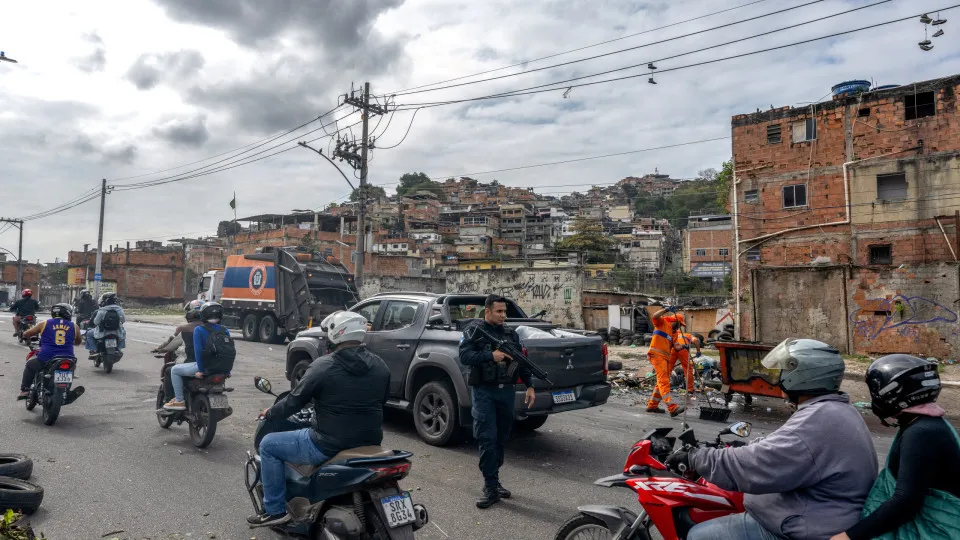
More than five million people, 32.2% of the population of Rio de Janeiro, live in territories with criminal groups, according to a survey by the state government.
© Pablo PORCIUNCULA / AFP via Getty Images
11/11/2026
by
Lusa
Mais of five million people, 32.2% of the population of the brazilian state of Rio de Janeiro, live in territories where criminal groups operate, between factions and militias, according to an unprecedented survey published by the state government.
Data, referring to 2025, were presented by the Institute of Public Security (ISP) in a technical note, in which 1,530 territories were identified subject to the performance of criminal organizations in different regions of the southeastern Brazilian state.
This is the first survey of this type published publicly by the government of Rio de Janeiro, although mapping work began in 2016, in partnership with the Military and Civil Police.
The study identified that the Red Command (CV) is the group with the highest territorial presence, acting in 779 areas, corresponding to 50.9% of the mapped territories, where almost three million people live, or 18.7% of the state population.
The militias appear in second place, with presence in 300 territories, where 917,105 people live, while the Third Pure Command (TCP) operates in 274 areas, which concentrate 914,859 residents.
The Friends of Friends faction (ADA) was identified in 91 territories, with 221.703 residents, while in 86 areas, with 126,274 inhabitants, informed the ISP, it was not possible to determine which criminal group had a predominant activity.
The survey also indicates that the territories with presence of criminal groups occupy an area of approximately 614 square kilometers, equivalent to 1.4% of the territorial extension of the state.
To identify these areas, the ISP considered elements such as barricades, circulation of armed men, firearms shootings, criminal activities and restrictions on the circulation of state agents.
The methodology also took into account disputes between rival groups and clashes with police forces during operations, patrols and investigations by public security agents.
The estimate of the resident population was made by crossing the territories identified with population data from the Brazilian Institute of Geography and Statistics (IBGE).
The IPS reported that the work was carried out in three major stages, in 2016, 2019 and 2025, with participation of the Military and Civil Police and, at different stages, collaboration of the Rio de Janeiro Public Ministry.
In the last update, the number of territories identified increased from 868 in 2019 to 1,530 in 2025, an increase of 76.3%.
The ISP, however, states that growth does not necessarily mean that criminal groups have expanded their presence to new areas, as the 2025 survey incorporated more sources of information and improved identification procedures.
According to the technical note, the previous results do not allow a direct comparison with the latest data, since part of the territories now identified may already be under criminal action in previous surveys, without having been mapped.