Myanmar’s military forces attacked the opposition in two days, causing more than 70 deaths, including children, according to reports from opposing groups and local media.
© AFP via Getty Images
29/11/2026
by
Lusa
Oair attacks by the military forces of Myamar in two days made more than 70 deaths, including children, according to opposing groups, an element of rescue teams and local media, reported the Associated Press (AP).
These were the last of a series of frequent and lethal aerial attacks by Myanmar's military forces, targeting armed pro-democracy groups and armed ethnic groups, which have often led to the death of civilians.
The government supported by the Armed Forces did not react immediately to the reported attacks. Previously, military forces had already said that the attacks target only legitimate targets of war, accusing resistance forces of being terrorists.
Myanmar has been seizing since the militia took power to the Government of Aung San Suu Kyi on February 1, 2021, triggering widespread popular opposition.
After peaceful demonstrations have been suppressed with lethal force, many opponents of the military government have taken up arms and a vast area of the country is now in conflict.
The attacks hit a wedding party, schools and residential areas. More than 70 people were injured in the state of Shan (west of the country), Rakhine (west) and Magway (center).
An air strike Saturday killed 21 civilians, including children, and injured 30 others, according to an interim regional government officer in the state of Karenni, an executive established by the resistance groups.
A fighter bombed a place where a wedding party was planned near a school and a displaced camp in the village of Le Kyi Lone.
“ Whether seen from the air or the earth, it is very clear that this site is a displaced camp, but bombing it deliberately and repeatedly is a war crime”, told AP Banya khung Aung, secretary of the interim executive of the resistance forces of the state of Karenni.
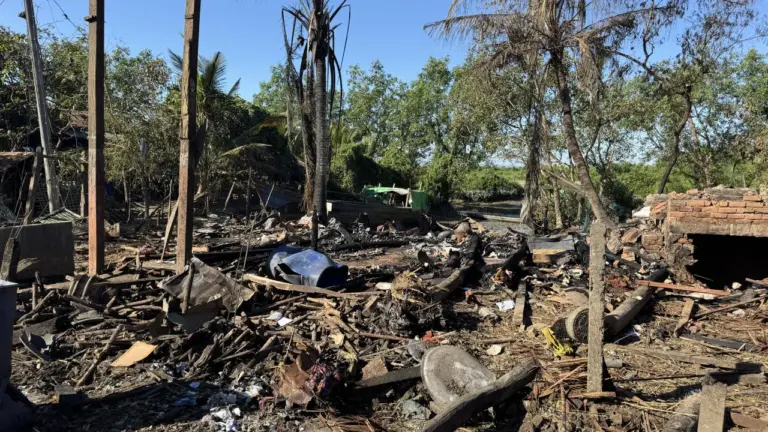
Two other bombings on Saturday hit a residential area in the state of Rakhine, killing at least 24 people and injuring at least 24 others, according to Wai Hun Aung, a member of the rescue teams, who rushed to the scene after the attacks and who admits that the number of victims may be higher.
“ Some bodies can't be counted. They were torn to pieces. They were all civilians,” he said.
Mrauk-U has been under the control of the armed ethnic group Arakan Army since February 2024, having already suffered an air raid on his hospital.
An attack on November 26, launched from a fighter, artillery pieces and drones hit a compound that housed a Buddhist school and monastery during a religious ceremony in the village of In Yone in the Magway region.
Some 20 civilians, including children and nine pro-democracy fighters, died, and 21 other people were injured, according to a statement issued by the Government of National Unity, the main organization of opposition coordination to the military regime.
The local media released photographs and videos showing what they said was the aftermath of the attacks, showing images and bodies and buildings destroyed.
The military government, which took office in April after a controversial election earlier this year, has increased attacks in recent months, by land and air, to resume areas controlled by opposition forces.
Resistance forces don't have an effective defense against air strikes.
The most recent attacks occurred one week after the International Court of Justice (TIJ) held Myanmar responsible for genocide against the Muslim minority Rohingya, in the first such decision against a state since the establishment of the court in 1945.
The court found it proved that the Burmese armed forces committed “undiscriminated murders”, separated and executed men and perpetrated widespread acts of sexual violence during the military operations carried out in 2017 in the state of Rakhine, when the current military leader of the country, Min Aung Hlaing, was commander of the army.
The decision, which obliges the State to investigate crimes, compensate victims and facilitate the return of displaced persons, was rejected by the Naypyidaw military junta, which claimed to have been adopted “without the participation of the legitimate representative of Myanmar” and therefore not reflect “the reality on the ground”.