
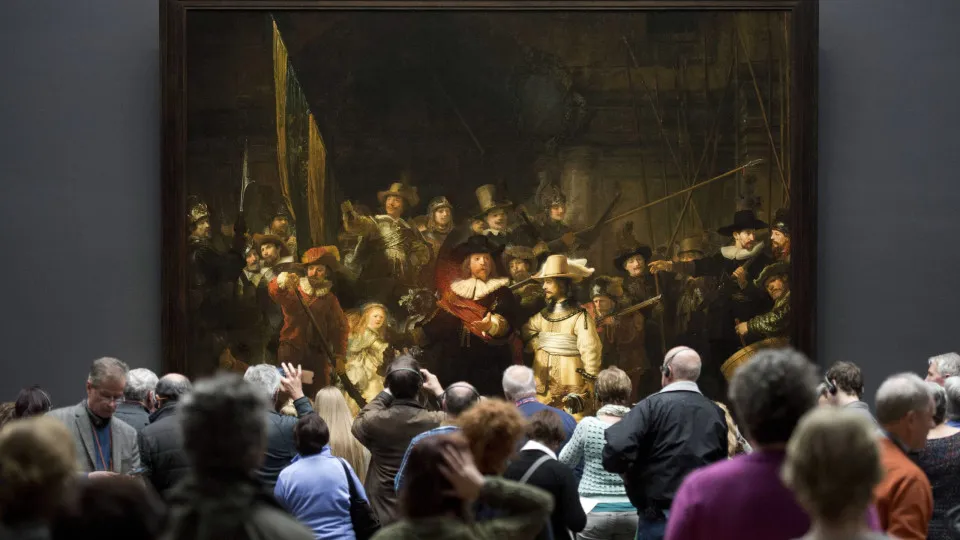
Rembrandt’s masterpiece “The Night Round”, painted nearly four centuries ago, houses invisible inhabitants, human skin bacteria, soil microorganisms and a species first identified in a sugar refinery in Japan.
© Lusa
11/11/2026
by
Lusa
Rembrandt
A rembrandt's masterpiece “The Night Round”, painted almost four centuries ago, houses invisible inhabitants, bacteria present in human skin, soil microorganisms and even a species first identified in a sugar refinery in Japan.
In order to arouse public curiosity about the invisible life surrounding humans, the Artis-Micropia museum laboratory, a “microbes zoo garden” in Amsterdam, joined forces with the Rijksmuseum works of art restorers.
The result is the exhibition “The Night Round Lives”, which reveals the microscopic world present in Rembrandt’s masterpiece.
The bacteria, isolated from samples taken over six months at about 60 spots of the painting and later grown in colonies, are exposed on Petri plates, next to a reproduction in real size of the work, at the Artis-Micropia museum.
“ We have found many microbes that are very often found, for example, in human skin or on the ground”, he explained on Tuesday to the agency France-Presse (AFP) Eline van Bloois, Artis-Micropia microbiologist.
Although the scientist ensures that the microbes present in the painting do not pose a risk to the work, she stresses that it is impossible to determine whether some of these microorganisms date back to the time of the great Dutch master.
“It would be very cute, wouldn’t it? If only we could establish a connection with Rembrandt (...) But unfortunately, when analyzing a single microbe, it is not possible to say if it has been there for 400 years or just one day,” added the 29-year-old scientist.
The results of the investigation are at least intriguing: in a place where the varnish had been removed from the painting for its restoration, scientists discovered a bacterium of the genus Saccharophyllum, commonly found in a region of Japan that houses a sugar refinery.
“This will keep me busy for years,” said Van Bloois, about this “true mystery.”.
“ This is the beauty of science: one question is asked and one comes across another hundred”, concluded the researcher.
The exhibition is part of a broader context, because “Operation Round Night”, is a large-scale research and restoration project focused on the masterpiece.
The work has been carried out since 2019 before the public in the Rijksmuseum, within a glass chamber designed specifically for this purpose.
“Thanks to this type of collaboration, we broadened our horizons and started raising issues of a different nature,” explained AFP Katrien Keune, scientific director of Rijksmuseum.
“ The knowledge we are acquiring can also be applied to other paintings ", stressed.
The exhibition is patent to the public since today and new samples will be taken in the coming months, enriching the exhibition gradually.