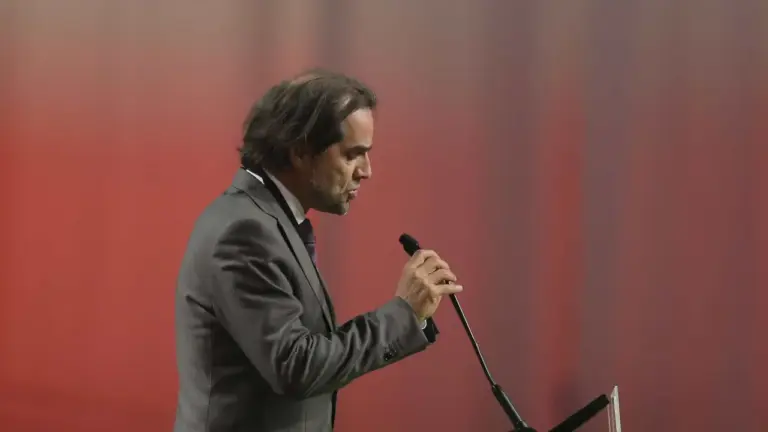
The president of the Government of Madeira, Miguel Albuquerque, said today that the region is a world reference in nature conservation, but the opposition pointed out flaws in environmental governance.
© Global Images
24/11/2026
by
Lusa
O president of the Government of Madeira (PSD/CDS-PP), Miguel Albuquerque, said today in the Legislative Assembly that the autonomous region is a “world reference” in nature conservation, but the opposition pointed out several flaws in environmental governance.
“In the Autonomous Region of Madeira, 65% of the land area and 89% of the territorial sea are under protection status. These values place the region among the regions that have the highest proportion of territory classified as protected in the European space”, he said, calling that only the forest area occupies about 48% of the territory, with 16,114 hectares of Laurissilva, classified as UNESCO's Natural World Heritage Site since 1999.
Miguel Albuquerque, also leader of the regional PSD, spoke in the thematic monthly debate with the Regional Government, today subject to the theme “Environment”, which was proposed by the executive.
The governor presented several data regarding the sector, such as the reforestation of 841.2 hectares since 2015, the creation of a fire strip with 315 hectares in the area of Funchal and the investment of 675,000 euros in monitoring air quality.
It also highlighted the projects in the systems of supply, sanitation and irrigation, which will absorb a total of 223.3 million euros by 2031, of which 141 million have already been made, as well as investment in increasing the capacity of the desalinizer of Porto Santo and in the renewal of the networks of the island, a total of 26.5 million euros.
Miguel Albuquerque focused, among others, on the investment of EUR 450 million from Madeira Electricity Company (EEM) in renewable energy production and adaptation of electricity networks in the last ten years.
“ Investment in renewable energy enables increased energy independence, saving more than EUR 50 million per year in fossil fuel imports and saving 25 million in CO2 licenses,” he said, indicating that in 2024 Madeira produced 36.4% of electricity from renewable sources, the “highest” percentage among the European Union’s outermost regions.
Albuquerque explained that the goal is to reach 55% by 2030 and, on the other hand, presented Porto Santo as an example, because the island will produce electricity from clean sources for 200 days a year from 2027, saving 3 million euros a year compared to fossil fuels.
During the debate, which also involved three regional secretaries – Eduardo Jesus (Tourism, Environment and Culture), Pedro Rodrigues (Infrastructures and Equipment) and Nuno Maciel (Agriculture and Fisheries) – the opposition benches criticized the executive policies in the Environment sector, pointing out several weaknesses.
By JPP, the largest opposition party, Rafael Nunes said that the president’s intervention was “pure propaganda” and classified governance as “completely catastrophic” in terms of the environment.
“ How were they able to choose this theme, if they were the true executioners of nature, forests and natural resources?”, he questioned, highlighting the cut of 65% of the funds for the sector foreseen in the proposal for the Region's Budget for 2027.
The JPP deputy also accused the executive of allowing “anarchy” in protected areas with the high load of tourists.
“Just walk through the hills to see the truth. They do not care about conservation, they want to know the money of tourists ", said.
The issue of fees charged for access to pedestrian routes marked a part of the debate, but Miguel Albuquerque reacted, reaffirming that Madeira is one of the “most advanced regions” in environmental terms and that the user/payer principle is fundamental to the balance of tourism activity.
Albuquerque stressed that the challenge is to reconcile tourism burden with nature preservation, using the fees for the recovery of rails.
The PS brought to the debate the project of Ponta do Pargo Golf Course, an investment by the Regional Government of about 62 million euros, currently under way, which also provides for a private investment in hotels and villas of about 138 million euros.
The leader of the socialist bench, Paulo Cafófo, questioned the option, when the proposed budget of the region for 2027 provides for a reduction in housing funds, allocating only EUR 37,7 million to build new houses.
The President of the Government explained that the golf course is an “anchoring investment”, decisive to boost the west of the island, from the outset with the creation of about 600 jobs rights and indirect.
During the debate, the bank of Aquida warned, among other things, that the production of energy from renewable sources in Porto Santo will have no impact on the consumer invoice, while the sole deputy of the Liberal Initiative, Gonçalo Maia Camel, classified the intervention of the executive chief as a mere “record display” and warned the pressure of tourism on Madeira’s natural heritage and the impact of “proliferation and increase of fees” on the reputation of the destination.
The non-attached Member Miguel Castro (former Enough) was concerned about water losses in the public supply systems, although the Regional Government has revealed that some 230 kilometres of network have been intervened in recent years.