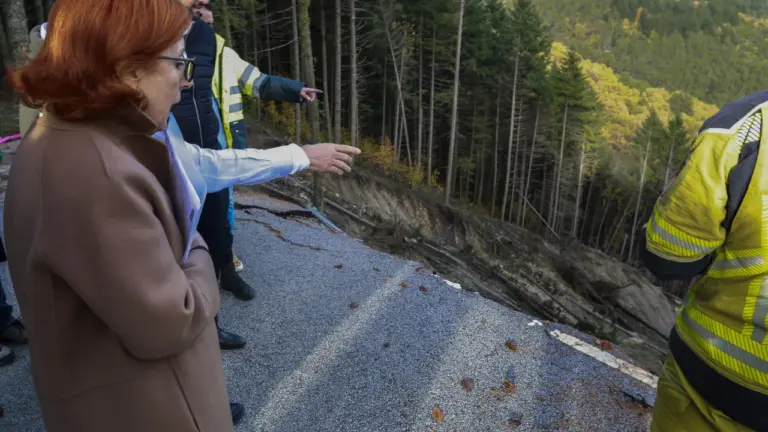
The Minister for Environment and Energy, Maria da Graça Carvalho, said that stabilizing the slope that caused the flood in Manteigas is a complex and time-consuming process, with urgent measures already in place.
© Lusa
23/11/2026
by
Lusa
A minister of Environment and Energy, Maria da Graça Carvalho, assured today, in Manteigas, that stabilizing the slope that originated the flood on Wednesday “is not a simple solution, nor easy, and will take long”.
“There is a sliding mass that needs to stabilize, first, and then remove, in the medium term. The urgent measures are already being taken, the others will take place in time, namely the stabilization of the land in the upper part of the hillside, next to the road [EN232]”, said the ruler at the end of a meeting in the House of Manteigas, in the Guard district.
The Minister of Environment visited today the area of Mata da Carvalheira, above the mountain village and point of origin of the landslide, stones and large trees that affected the urban area on Wednesday night, November 18.
“ The causes are very remote. We are facing a mountain area that has several groundwater streams, has a lot of erosion, it is a very deteriorated territory over the years due to the weather, the winds, and there may also have been influence here of a small earthquake that occurred in January ", said Maria da Graça Carvalho.
The entourage was also on the Silver Bridge in Manteigas, to learn about the technical interventions to minimize the impacts of the floods that occurred, before meeting in the Palaces of the Council to analyze the proposed measures for the future.
At the table was a report from the National Laboratory of Civil Engineering (LNEC), which proposes “in the medium term” the stabilization of the affected land in the Forest of the Carvalheira through the creation of terraces to sustain the slope.
“It is the hardest and most expensive part, because it is a profile of the slope along the Ribeiro da Vila, but we have to follow what the LNEC tells us to do. There is then the regularization of Ribeira da Vila, which will already be the responsibility of the APA [Portuguese Environment Agency], which is complex, but is simpler than the previous one”, he considered.
This will include the demolition of existing bridges, the construction of barriers to reduce the flow and installation of water energy reducing elements.
The cleaning of the Ribeiro da Vila bed, the sealing of the cracks in the Carvalheira with concrete or canvas, the cutting of some very large trees and the reinforcement of the banks of the riverside with large blocks, are other actions to be performed.
“ They are immediate measures, such as preventing the movement of pedestrians and vehicles when there is a lot of rain and the withdrawal of people living in houses located near the riverside in case of danger,” he added.
The minister did not commit to deadlines or the necessary investment.
“I have already called the Secretary of State of the Territory to meet urgently, also to involve the PTRR [in financial terms] and operationalize this, putting the solution on the ground,” said Maria da Graça Carvalho.
Flávio Massano, mayor of Manteigas, said in turn that “we had a very serious scare [on Wednesday] that could have had much worse consequences”.
“ It was another opportunity that was given us to solve this problem, which we are not able to solve at the municipal level.”.
The independent mayor was the only one to speak today in an estimate of the costs required for the intervention, stating that one of the elements involved in the cleaning and consolidation work after the flood pointed to “a figure of around EUR 10 to 20 million”.
Maria da Graça Carvalho heard and admitted that the solution “is not simple, it will always be of this order of grandeur or superior”.
Present at the meeting, João Rodrigues, Subregional Commander of Emergency and Civil Protection of Beiras and Serra da Estrela, said that “the occurrence will remain open in the coming months, because the risk remains”.
“ We have cameras installed in Carvalheira, sensors along the bed of Ribeiro da Vila, the IPMA will warn us in advance for the forecast of heavy precipitation and we will keep a machine in stay to disassembly the stream ", indicated.