
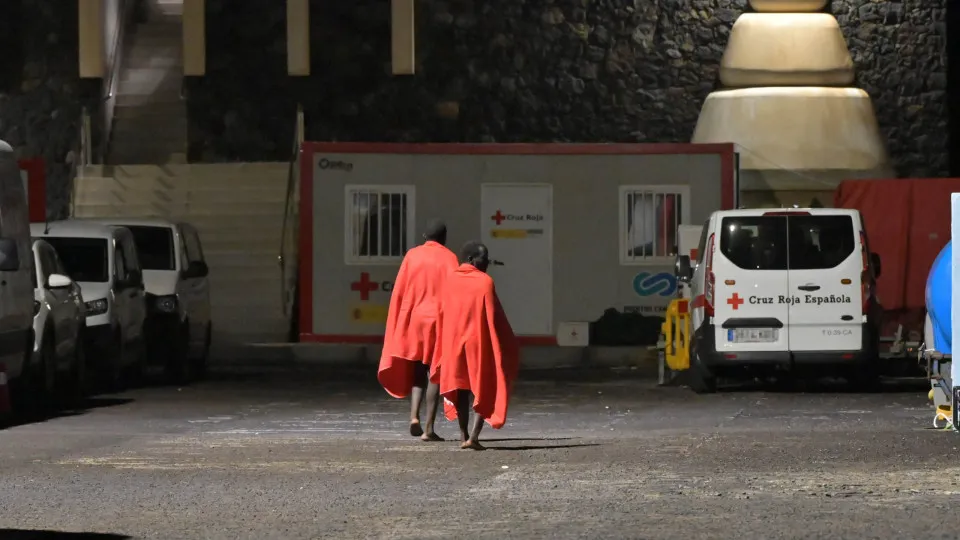
The number of unaccompanied migrant children under the supervision of the Canaryian government rose from 2,300 to more than 3,000 in 15 days, according to the Director-General for the Protection of the Child and the Family of Spain.
© Europa Press Canarias via Getty Images
11/11/2026
by
Lusa
O number of migrant children unaccompanied under the protection of the Government of the Canary Islands increased from 2,300 to more than 3,000 in 15 days, today the Director-General for the Protection of the Child and the Family of Spain advanced.
In addition, the children arriving in the archipelago are “increasingly younger,” said Sandra Rodríguez, during a visit to La Restinga, a village in the southern end of El Hierro where many of the migrants rescued at sea near this island are landed.
As indicated, in some cases, the initial screening assigns 16 years to children who appear to be much younger, which led the Directorate-General to ask the Public Prosecutor to review the ages recorded in these descriptions so that, when children are transferred to other autonomous communities, they can be referred to foster homes and receive appropriate care.
The person in charge took the opportunity to announce the reopening of a large center in La Laguna (Tenerife) to welcome children and adolescents arriving, especially El Hierro, where 248 minors are already housed.
The Canary Islands, and above all El Hierro, they have been pressured by the number of migrants arriving on the islands, and the regional government has counted at least 6,000 people since November 1.
The situation led to the declaration of “migratory emergency” in the Canary Islands, especially on the island of El Hierro, with the president of the regional government, Fernando Clavijo, defending the urgent need for a strengthening of the health response for migrants, namely the creation of a campaign hospital.
El Hierro is the smallest inhabited island in the Canary Islands, where some 12,000 people live, and the one to which most of the precarious vessels (known as ‘pateras’ or ‘cayucos’) are arriving with migrants.
The increase in arrivals forced the Canary Islands government to reopen centers in Tenerife that had been closed since the summer, Sandra Rodríguez explained.
The Director General added that, in addition to dealing with the initial reception, her department is reorganizing the spaces on the different islands to assign accommodation based on age, sex and possible doubts about the age of children.
In El Hierro, where the emergency response services of the Canaryian government received 300 minors, the local authorities again provided two shelters, in case arrivals overloaded the island's resources.
In their opinion, in these cases, entry into the network should take place after testing for age.
The so-called Atlantic migration route, which departs from Morocco and Western Sahara, on its shortest path, and Mauritania, Senegal, Gambia and Mali, on the longest crossings, is considered one of the most dangerous in the world, with crossings taking several days or even weeks in the open sea.
Despite the decrease in crossings towards the Canary Islands in the last two years, the lethality of the route has increased due to the opening of longer and more dangerous routes (such as those leaving Guinea-Conakry or the Gambia).
The flow of ships on the route usually intensifys in the autumn – a phenomenon known locally as “the crisis of the ‘cayuks’ – mainly due to a typical calming of the winds in the area during this period, which makes the sea easier to navigate.
Estimates from the UN indicate that in 2025 they reached the Spanish islands 17,788 irregular migrants aboard 263 vessels.
The UN also documented the death or disappearance at sea of at least 416 people, while the non-governmental organisation (NGO) Caminando Fronteras points to 1,906 deaths on this route as early as 2026.