Israel’s attacks on medical personnel in the West Bank and East Jerusalem increased “drastically” after October 7, 2023, according to a report published today by an Israeli NGO.
© JOHN WESSELS / AFP via Getty Images
23/11/2026
by
Lusa
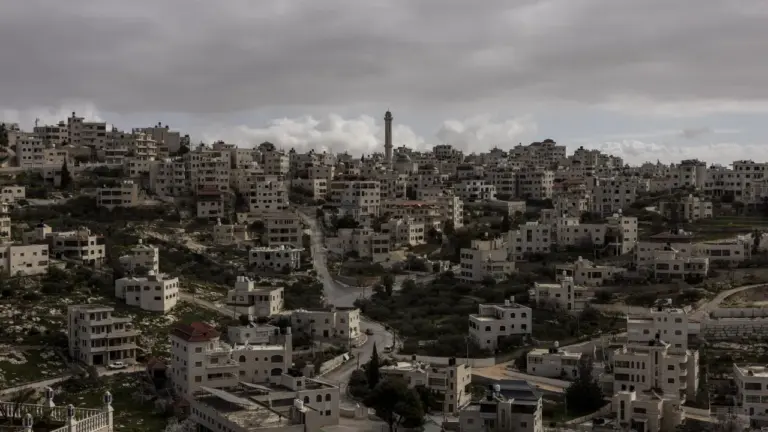
“ O we realize that when you're a paramedic and you're identified as a paramedic, it ends up causing problems. They can attack us directly because we are marked as paramedics,” he explained to the news agency EFE Imran Anati, researcher at the NGO Doctors for Human Rights Israel (PHRI), and author of the report, presented by the organization a few days before its publication in the Palestinian locality of Aqraba, in the north of the West Bank.
In a room of the local city council, Anati presented, together with other members of the PHRI and Palestinian paramedics, the results of the report entitled “Arrive, provide care, survive: Israel’s attacks on ambulances, health professionals and emergency services in the West Bank”.
Anati highlighted the elements that distinguish this report from the usual aggressions of Israelis against Palestinians in the West Bank over decades, stressing that “Israeli soldiers and settlers act at the same level by not allowing the Palestinian community to exist”.
World Health Organization (WHO) data show a sharp increase in attacks on the medical emergency system in the West Bank and East Jerusalem: from 93 aggressions in 2022 to 233 in 2025. The WHO further underlines that each recorded incident may include several attacks of a different nature.
According to the PHRI report, this situation has led to the erosion of the principle of medical neutrality through three patterns of aggression: the increase of road blocks and restrictions on road traffic, the direct attacks on medical teams and the normalization of the humiliation and intimidation of health professionals.
“ They once destroyed my ambulance. All the windows: windows and rear window were reduced to shrapnel. The bodywork also suffered several damages; in several points, they threw stones at the vehicle ", told EFE the paramedic Bashar Qariuti. The settlers even tried to burn down the vehicle, he explained.
“ While heading for Aqraba, they launched arson devices against the ambulance with the intention of burning it,” he added.
Qariuti recalls that his life was in danger on five occasions due to direct attacks while working, but stresses that it was one of his ambulance colleagues who eventually lost his life. This is Mohamed Awad of the Palestinian Red Crescent, killed by shooting of Israeli settlers in April 2024.
The direct attacks add to the complex system of military checkpoints and gates arbitrarily managed by the Israeli Army and sometimes by the settlers in the West Bank.
These obstacles hinder the circulation of the local Palestinian population and, in the case of ambulances, cause paramedics to waste crucial time to respond to emergencies.
Data from the United Nations indicate that obstacles to circulation in this territory increased from 642 in June 2023 to 925 in December 2025.
“ We arrived at a checkpoint with a wounded patient who was losing a lot of blood. The Israeli soldier started calling senior officers to ask them what to do. They made us wait ten minutes [...] it was the longest ten minutes of my life”, reports in the report a nurse, Rana.
The document also describes the psychological impact of working under this level of violence.
“ We assumed so many aggressions, so many traumatic experiences [...] things capable of crushing mountains and, still, we keep going ", summarizes Qariuti.
Paramedics interviewed by PHRI claim to suffer from persistent anxiety, exhaustion, loss of control and insomnia. In addition, their personal relationships are affected, since many choose not to tell families what they live to avoid worrying them.
“ There is no clear distinction between work and home, because they are volunteers in the same spaces where they live: places marked by checkpoints, restrictions and violence”, the report warns.