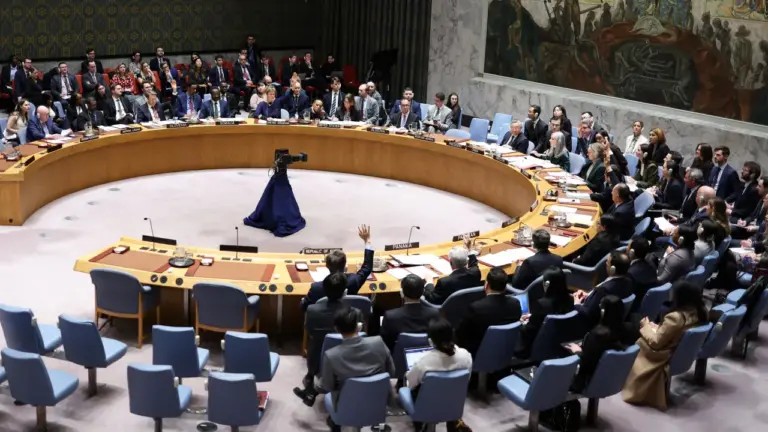
The UN risks starting 2027 without Secretary-General due to the lack of consensus in the Security Council on the successor of António Guterres, with the five veto-right powers divided between three candidates.
© CHARLY TRIBALLEAU/AFP via Getty Images
27/11/2026
by
Lusa
A UN risks starting 2027 without Secretary General due to the lack of consensus in the Security Council on the successor of António Guterres, with the five powers with veto rights divided between three candidates.
This scenario was explained to Lusa by Richard Gowan, analyst of the International Crisis Group, who describes the current situation as “very confusing.”.
Gowan, a specialist in the UN system, admits that, about a month before the end of António Guterres' term of office, the expectation was that members with veto power – China, the United States, France, the United Kingdom and Russia – would try to settle their differences in private before the ninth informal vote last week.
However, the five permanent members of the Security Council “appear as far away as before”, since no candidate for the post of UN Secretary-General could emerge without any opposition at the last vote.
In an interview with Lusa, the specialist in the UN system, the Security Council and peacekeeping operations rejected the disagreements concerning the political positions of the candidates, but the favorites of the main powers.
Five women and three men are currently in the race to succeed the 77-year-old Portuguese Prime Minister António Guterres, who will conclude his second five-year term on 31 December.
They are candidates Rebeca Grynspan (Costa Rica), Rafael Grossi (Argentina), Carolyn Rodrigues Birkett (Guiana), Lana Nusseibeh (United Arab Emirates), Ivonne Baki (Ecuador), Olara Otunnu (Uganda), María Fernanda Espinosa (Ecuador) and Feridun Sinirlioglu (Turquia).
To win the selection process, which has been dragging on for months, a candidate will have to obtain the consent of at least nine members of the UN Security Council, avoiding the veto of any of the five permanent members.
The name will then be submitted to the General Assembly, which in practice follows the recommendation of the Security Council.
However, the Council is at a standstill. No candidate has yet achieved zero “votes against” in the nine informal votes already held.
“I believe that countries with veto powers are divided among three main candidates, although their divisions are quite complex,” International Crisis Group analyst Lusa, a non-governmental organization focused on resolving and preventing international armed conflicts, told Lusa.
Gowan sees the dispute blocked between Grynspan, Nusseibeh and Grossi.
Therefore, in the face of the impasse, the expert does not rule out the possibility of the United Nations entering 2027 without a new Secretary-General.
In this scenario, the hypothesis “is that some kind of committee of senior UN officials would conduct routine work while the Security Council would seek consensus,” he explained.
“ But I think [countries with] veto powers will probably find a consensus in the end, even if it is just to avoid looking incompetent,” he noted.
Following a geographical tradition not always respected, the position is claimed by Latin America, which explains the fact that most candidates are from this continent.
Many countries also argue that it is a woman who holds the office of Secretary-General for the first time in the 81 years of UN history.
In practice, there is no official deadline for choosing the next UN leader, nor is this an unprecedented situation.
Former Secretary-General Kofi Annan of Ghana was chosen to be the seventh leader of the UN on 13 December 1996, a few weeks from starting his term.
In 1981, a Secretary-General was only selected after 16 inconclusive voting rounds.
On the other hand, António Guterres was chosen on October 13, 2016, after six rounds of informal vote on the Security Council.
Costa Rican Rebeca Grynspan has consistently been the most supported candidate this year, but has failed to avoid opposition from some permanent members.
Last week, U.S. Ambassador Mike Waltz advised candidates with less support to give up the race to facilitate a faster consensus.
António Guterres has been asked whether he is willing to extend his term of office for six months if the UN Security Council is unable to appoint a successor by the end of the year. However, he has pushed away this possibility and says he wants to return to Portugal by early January.
Unless secret negotiations between the vetoed countries result in a change from the current deadlock, the UN may be forced to choose an external candidate — someone who is not currently in dispute.
The next informal vote is scheduled for Monday, November 30.