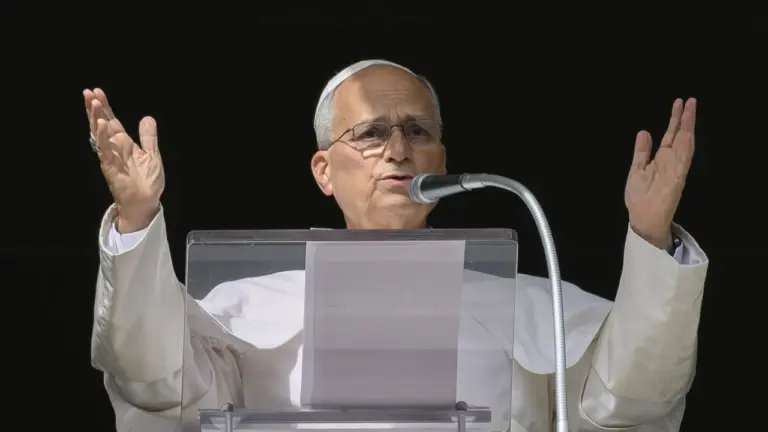
Pope Leo XIV today warned of the consequences of militarization of artificial intelligence (IA) and defended interreligious dialogue and education as tools to overcome conflicts and divisions.
© Elisabetta Trevisan – Vatican Media via Vatican Pool/Getty Images
26/11/2026
by
Lusa
O Pope Leo XIV today warned of the consequences of militarization of artificial intelligence (IA) and defended interreligious dialogue and education as tools to overcome conflicts and divisions.
He expressed this position before the participants in the XV Plenary Assembly of the Dicastery for Interreligious Dialogue, whose members he received today, after two days of meetings in Rome under the theme “The contribution of interreligious dialogue to education for unarmed and disarming peace”.
Leo XIV stated that the current wars put to the test “the bonds of the human family” and stressed, therefore, the importance of interreligious dialogue which, as an expression of the Church’s evangelizing mission, “does not compromise the principles of the Gospel” or weakens its missionary vocation.
“The dialogue — he added — bears witness to a harmony based on truth, embodied in charity and sustained by hope,” according to the Vatican News portal.
In recalling the Church’s mission “to be at the side of all those whose dignity is threatened and to bring hope to those who live a reality marked by violence and suffering”, the Pope warned of the “militarization of artificial intelligence”, which “threats peace by giving machines the ability to decide on people’s life and death”.
From their perspective, “these challenges to harmony, added to other derivatives of technological progress, invite us to rediscover the meaning of ‘total disarmament’, which cannot be achieved only by means of political agreements or the mere reduction of arsenals.”.
For this reason, he considers that “to face them requires a profound transformation of hearts and minds”.
Referring to the encyclical ‘Pacem in terris’, by John XXIII, in which he stressed that total disarmament involves transforming people’s souls, Leo XIV recalled that “religions also have an essential role to play in alerting against the growing temptation to transform even thoughts and words into weapons.”.
Hence the importance of education, since peace requires “a way of relating to others that respects the dignity of every human person” to overcome hatred, resentment and indifference.
“ At a time when fear and prejudices are so easily amplified, especially in digital environments, it is necessary to promote a culture of the encounter that helps young people to communicate responsibly, to discern wisely and to build bridges beyond differences,” he said.
For the head of the Catholic Church, education for peace and dialogue are two fundamental pillars for building bridges and overcoming divisions.
It is, he said, a dialogue that must be cultivated in families, parishes, schools and workplaces, “to become an integral part of daily life, rather than just a tactic or an instrument”, and he urged each local Church to “draw with patience the seeds of trust, mutual understanding and fraternity through dialogue”.
“ In time, these seeds can bear fruit to the service of harmony and the integral development of each person. May we never tire of building bridges, overcoming divisions and bearing witness to the hope and peace that are a gift of the Risen Lord”, concluded Leo XIV.