
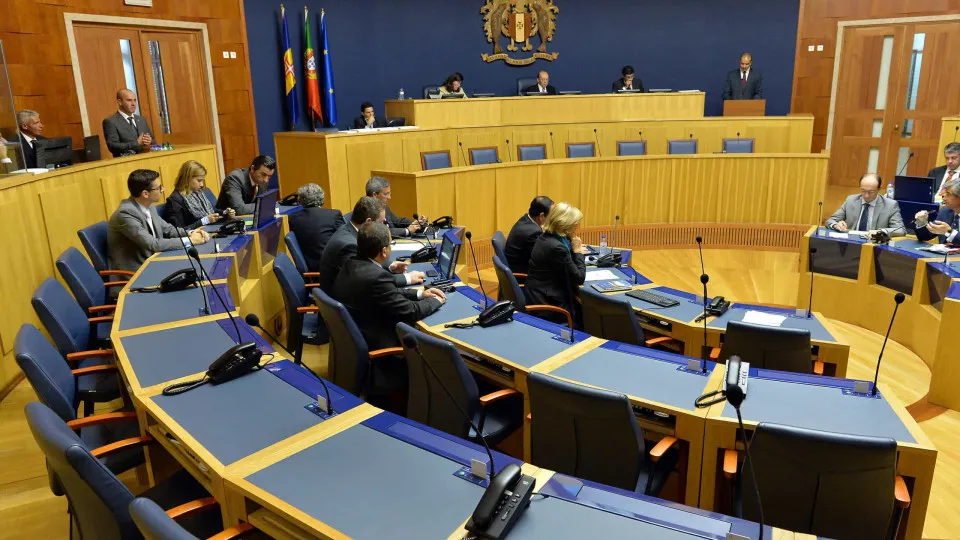
The Madeira Legislative Assembly postponed the plenary from Wednesday to Thursday due to bad weather forecasts in the region, with the aim of avoiding unnecessary road traffic.
© Global Images
10/11/2026
by
Lusa
A The Madeira Legislative Assembly decided today to postpone the plenary scheduled for Wednesday to the next day, due to bad weather forecasts for the region, for prevention and to avoid unnecessary road traffic.
The proposal was made by the chairman of the Madeiran parliament, Rubina Leal, at the end of today's plenary, and was supported by Members.
The southern coast and the mountainous regions of Madeira Island will be starting at 9:00 p.m. today under red weather warning, the most serious, due to rain forecast, sometimes strong and persistent, according to the Portuguese Institute of the Sea and Atmosphere (IPMA).
The red warning will be in effect until 06:00 on Wednesday, then the orange (second level on three) until 09:00.
The mountainous regions of Madeira Island will also be with red warning because of the strong wind, with gusts up to 140 kilometers per hour, between 00:00 and 06:00 on Wednesday.
The red warning is issued by IPMA in cases of extreme risk weather situation. The orange warning indicates a moderate to high risk weather situation and the yellow risk for certain activities dependent on the weather situation.
The Regional Government decreed the closure of Madeira's schools in the morning of Wednesday and the pedestrian routes throughout the day.
In today's plenary, the PS/Madeira argued that regional support should be created for the tuition of Madeiran students in higher education aimed at the progressive elimination of this burden, considering that regional autonomy should serve to adopt specific measures to help young people.
“Regional autonomy should enable it to create its own answers,” said Socialist MEP Sancha Campanela in presenting a draft resolution recommending to the Regional Government (PSD/CDS-PP) that it fosters support for the tuition of Madeiran students.
This elect of the PS argued that “the future of young people should not be conditioned by the place where the young person was born”, indicating that tuition fees represent a value of around 632 euros and that 42% of Madeiran students receive scholarship from the Directorate General of Higher Education (DGES).
The PS wants the support to cover “all Madeiran students regardless of the establishment they attend, which covers those who study in Madeira”.
Jéssica Teles, from Together for the People (JPP), considered this proposal “positive” and stressed that “the burdens weigh heavily on the family budget” when families have students, especially attending educational establishments abroad or away from home.
However, he pointed out that the document “does not set a deadline for reaching all students”, nor what the criteria for school use are, and does not provide for extension to non-integrated master’s degrees, so the party can submit proposals for amendments if the initiative is approved.
According to the PSD, Valter Correia argued that the PS should present a proposal in the Assembly of the Republic “to end tuition”, but opted for an “unacceptable” measure, which is the Regional Budget to assume this burden, when the “Republic has been choking the University of Madeira”.
“ Autonomy does not serve to disresponsabilize the Republic from its constitutional duties”, he stressed.
Manuela Gonçalves, do Cávez, argued that the PS presents “a project that fails the target and forgets who needs the most response, the working middle class”.
The MP pointed out that Madeira “has already a system of scholarships that the student can accumulate with that of DGES”.
The non-attached deputy (former Arrive), Miguel Castro, opined that “assistance measures should have as final objective the profitability of students”, stating: “Help, yes, those who need it most, but also demand that the beneficiaries have results at the end of the school years.”