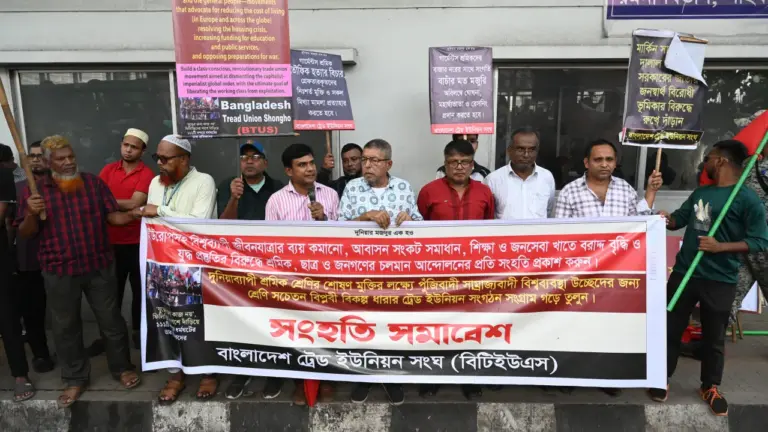
The strikes and demonstrations of workers in the textile sector in Bangladesh have caused losses of more than $428 million (about €390 million), said today the main employer association, which called for a return to normality.
© Mamunur Rashid/NurPhoto via Getty Images
22/11/2026
by
Lusa
Bangladesh
Athe strikes and demonstrations of workers in the textile sector in Bangladesh caused losses of more than $428 million (about 390 million), said today the main employer association, which called for a return to normality.
“ With the (...) social movement underway, 317 manufacturing plants suffered losses worth 428 million dollars, while orders worth 254 million dollars were transferred to other countries,” says a statement from Bangladesh’s Association of Manufacturers and Clothing Exporters (BGMEA), quoted today by the news agency France-Presse (AFP).
The conclusion is the result of an inquiry made by the association with its members on the impact of the actions conducted by this movement that claims better wages.
“ The actual losses may be much higher”, warned the association, which noted that only half of the 600 factories affected by the movement were able to respond to the survey in a timely manner.
In the document, BGMEA’s Secretary-General Shahedul Islam considered it “imperative to overcome this critical situation as soon as possible”.
The question is: “the interest of the country’s economy and the livelihoods of millions of workers”.
The workers of the Bangladesh textile industry, who produce for major international brands, have mobilized through demonstrations and strikes, demanding the doubling of the monthly minimum wage to 30,000 taka (about 220 euros), against the current 12,500 taka (91,5 euros) in a context of strong inflation.
These protests, which led to clashes with security forces, affect what is one of the key sectors of the country's economy, which is the second largest exporter of clothing in the world, after China.
The textile industry employs about four million of the country's 170 million inhabitants and accounts for most of the country's export earnings.
According to BGMEA, the claim movement damaged production, delayed deliveries and undermined the trust of international customers.
“ These disturbances have also affected the image, reliability and prospects of Bangladesh’s textile industry on the world market,” added the association’s head.
The social movement appears on the eve of the end of the year, the busiest period for exports of this sector of the country.
At the beginning of the month, the government appointed a committee composed of representatives of workers and employers, and should announce a new minimum wage by December.
According to INE data, in 2025, the Portuguese import of textile materials and their works from Bangladesh represented EUR 105.2 million.