
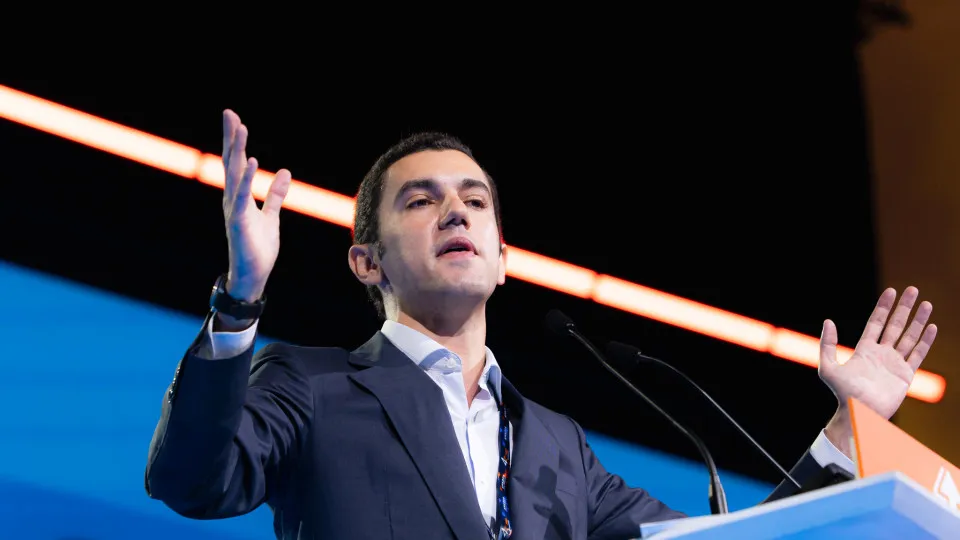
The spokesman and vice president of the PSD said today he believed that unfavourable polls to the government would “change very quickly” if PS and Arrive joined to overthrow him, expressing confidence that “the results will be there” at the end of the legislature.
© João Pedro Domingos / PSD
01/10/2026
by
Lusa
Na lunch-debate promoted by the International Club of Portugal, also MEP Sebastião Bugalho made an intervention on the theme “Europe – geopolitical dwarf or preferred partner?”, but, in the phase of the questions, he was asked about the various opinion studies that have put the PSD/CDS-PP coalition in third place, behind PS and Enough.
The MEP said he was not indifferent to what polls show that people contacted are thinking at the moment, but he answered with another question.
“What would the polls say if the E.R. and the Arrivo collide in parliament to overthrow the government? Were they going to keep saying the same thing? (...) I think the polls would change very quickly ", said.
The Social Democratic leader has yet to justify not being concerned about the scenarios that polls point to because he is convinced that the legislature will last until the end, 2029.
“The day we are called back to the polls the results we all want will be there,” he said.
Bugalho considered that the minority executive PSD/CDS-PP is succeeding in doing what many considered impossible, even in the context of international instability.
“Will there continue to be State Budgets? Go on. Will there still be reforms? Go on. Will there continue to be political stability in what depends on us? Yes”, he defended.
In his speech, Sebastião Bugalho praised the entire executive, but highlighted in particular the capacity that three ministers – all former MEPs – have had to influence the European Commission: Paulo Rangel, Maria Graça Carvalho and José Manuel Fernandes.
“ Portugal often does things first in Portugal that are then reproduced in Europe. And they are often proposed by the Portuguese ministers – and of these I have mentioned in particular – who influence what will then be done by the other 26 European Member States,” he said.
The MEP pointed out as examples the position of Portuguese diplomacy on the Middle East, the “Water One” strategy and the insurance mechanism against natural disasters, arguing that the latter two national programmes “influenced two of the main proposals of the European Commission in the most important speech of the year in the European Parliament”, the State of the Union.
“There is no government that is not influential, that is not competent and that does not boldly achieve this kind of European influence,” he said.
In an ironic note, he ensured that, with these examples, he is not arguing that “the MEPs give excellent ministers”, adding: “But the fact is that they do.”.
In response to the central theme of his speech, the future of the European Union, Sebastião Bugalho, was optimistic, saying he trusted that by the end of the decade “Europe will become the preferred partner of all those who want to have partners in the world” and even “an economic superpower”.
“Europe, between coercion and trust, chooses trust. Between stability and disruption, you choose stability. Between war and security, he invests in the second to avoid the first and resists the first to preserve the second. We Europeans know that nowadays, any form of isolation does not mean autonomy, on the contrary, it harms those who want to be autonomous”, he said.