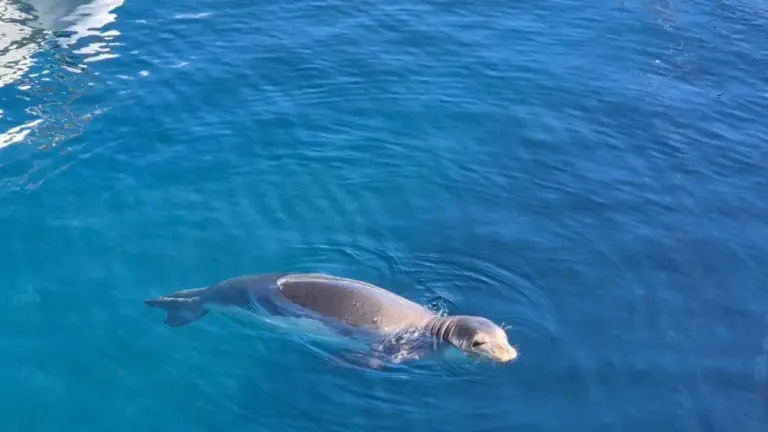
The first sea wolf cub observed this year in the Desert Islands in Madeira was named Madeira Ocean, according to the Regional Government, which highlighted the recovery of the species, which went from eight individuals in 1988 to more than 30 today.
© Reproduction/ Institute for Forests and Nature Conservation, RAM
23/11/2026
by
Lusa
A the first sea wolf cub observed this year in Madeira, in the Desert Islands, was named Madeira Ocean, today indicated the Regional Government, highlighting that the species has gone from eight individuals in 1988 to more than 30 today.
“The assignment of names to the cubs is part of the accompaniment of the marine wolf population (Monachus monachus) in the Desert Islands. In this case, the choice of the name Madeira Ocean assumes a particular meaning, by symbolically representing the continuity of a conservation work that has allowed the gradual recovery of the species in the region ", says the Regional Secretary of Tourism, Environment and Culture in a statement.
The Madeira Ocean Program was formalized this year and aims to support the evaluation, management and strengthening of the Protected Marine Areas Network of the Autonomous Region of Madeira, through the production of scientific knowledge, training and public involvement.
“ Each birth of a sea wolf is the affirmation of a capacity and work that comes from behind. It is, at the same time, a hope of continued recovery, a hope of continuing to improve what we do,” says the regional secretary, Eduardo Jesus, quoted in the statement.
The ruler highlights the symbolism of associating the birth of another marine wolf with the scientific program promoted by the Regional Government (PSD/CDS-PP), in partnership with the Blue Ocean Foundation, ARDITI – Regional Agency for the Development of Research, Technology and Innovation – and the National Geographic Society/Pristine Sea.
The path of recovery of the seawolf in Madeira is considered one of the most relevant examples of the nature conservation work developed in the region.
In 1988, the population consisted of only eight animals, but currently has just over 30 individuals, with an increasing number of breeding females, with an average record of four to five offspring per year.
“ Despite this positive development, the recovery continues to be gradual and faces natural challenges, says the statement, noting that the Desert Islands, located about 40 kilometres from Funchal, constitute the last refuge of the species in Madeira.
The breeding season coincides with the months of greater maritime instability and juvenile mortality is therefore naturally high.
The protection of the Desert Islands and the permanent monitoring of the population are crucial for the recovery of the species, and the work carried out by the regional authorities included measures aimed at controlling the fishing activity.
“ The long-standing ban on gillnets, identified as one of the causes of animal mortality, has been accompanied by a dialogue process with fishermen, the collection of these nets and the provision of alternative fishing gear,” he says.
The Secretariat of Tourism, Environment and Culture underlines that, in addition to direct protection of habitat and species, awareness and community involvement remain “critical success factors”.
“ The sea wolf is a species particularly cherished by Madeirans and has played an important role in bringing the population closer to the themes of nature conservation,” says Eduardo Jesus, warning, however, about the need to promote adequate behaviors in his presence.
“ For example, feeding animals or staying in water when they are in bathing areas are examples of interactions that can cause habituation to the human presence and harm the species,” he says.