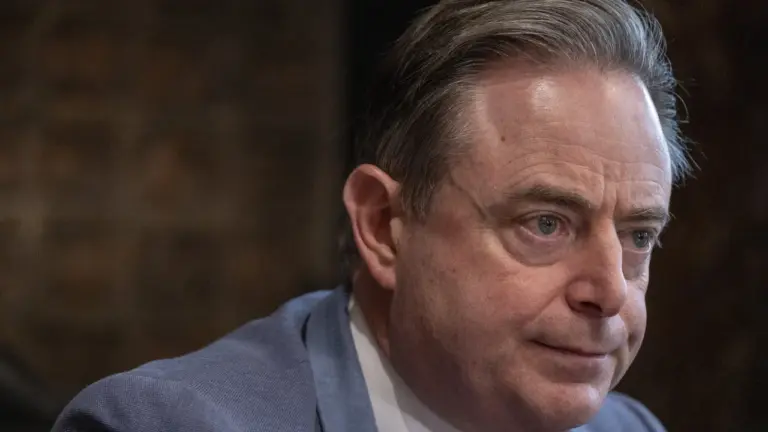
The Belgian Prime Minister, Bart De Wever, decided to remain in office despite the impasse in approving the budget, with the king encouraging the continuation of negotiations.
© NICOLAS MAETERLINCK/BELGA MAG/AFP via Getty Images
23/11/2026
by
Lusa
O prime Minister of Belgium, Flemish nationalist Bart De Wever, today decided to remain in office despite the lack of agreement for the State Budget.
De Wever communicated to King Philip I its intention to continue to seek a pact to enable an adjustment of EUR 10 billion by 2029.
The head of the government recognized before the monarch that there has not yet been “no decisive advance” that would allow an agreement to be reached between the five parties in his coalition, the Royal Palace informed after the hearing.
“ While regretting the absence of significant progress, the king encouraged the Prime Minister to persevere in reaching an agreement as soon as possible,” the Belgian Royal House said.
The monarch also made “a new appeal to all parties involved to assume their responsibilities and put the general interest first” in order to avoid a prolonged crisis, emphasizing the importance of prioritizing dialogue, with “discretion and mutual respect”.
The Royal Palace reported that De Wever will continue to keep the king up to date during the next weekly hearings, without setting a new deadline for reaching a consensus.
The hearing took place after a meeting of the Chief Executive Ministers on a restricted ministerial committee known as “kern”, which ended without agreement.
Negotiations have been under way since 15 November, when the Flemish Socialists of the Vooruit party refused to continue talks on the basis of the budget proposal put forward by the Prime Minister — a proposal that had been accepted by the other four coalition parties.
Vooruit advocates a greater tax contribution from higher incomes and fewer cuts in health and pensions, while the French-speaking liberals of the Reforming Movement (MR) oppose the increase in tax burden.
De Wever had already submitted his resignation to the monarch on 2 November, in the face of a lack of agreement; however, the king rejected the request four days later and instructed him to resume negotiations — a request he reiterated on 16 November.
The crisis coincides with a day of trade union protests against the economic and social reforms of the government, causing significant disturbances in air and public transport.
With the exception of emergency flights, Belgian airspace will remain closed today, from 7:00 to 9:00. There were also serious disturbances in the metro, trams and buses of the capital, where a great demonstration walks the streets with a message against austerity policies.
Last Friday, the credit rating agency Fitch maintained the Belgian sovereign debt rating on A+, with a stable outlook, although it warned of the high political uncertainty and the risk of the budgetary deadlock aggravating public debt.
According to the European Commission's latest forecasts, the government deficit will reach 5.2% of gross domestic product (GDP) in 2026, 5.5% in 2027 and 5.7% in 2028, while the debt will increase to 115.8% of GDP at the end of that period.