
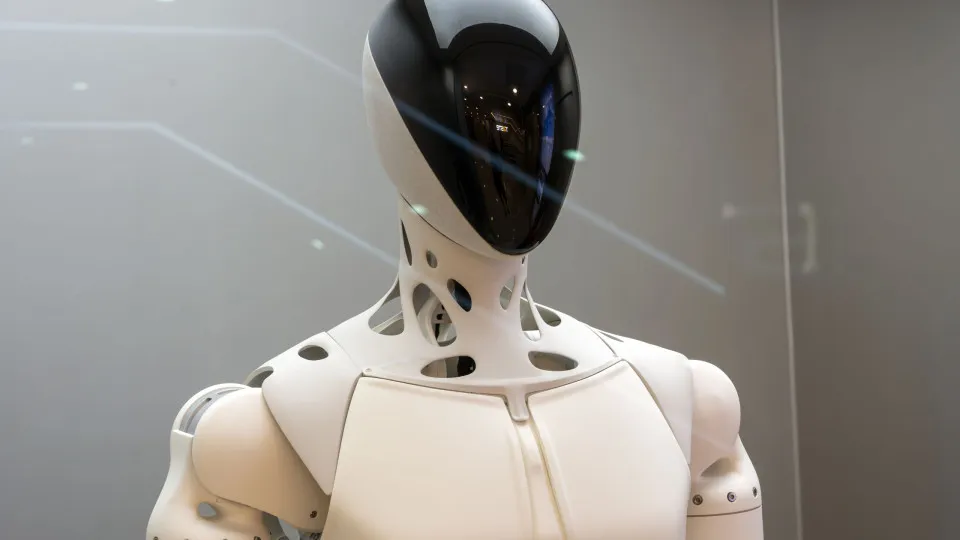
Santarém Polytechnic University seeks funding to test a humanoid robot in home support, day care centers and homes for the elderly, evaluating the contribution of artificial intelligence to care for older people.
© Getty Images
12/11/2026
by
Lusa
A Santarém Polytechnic University seeks funding to test a humanoid robot in home support, day centers and homes for the elderly, evaluating the contribution of artificial intelligence to care for older people.
“ After a previous study, the equipment that we think is most interesting to test in Portugal is a version of the Chinese model Unitree R1”, revealed to Lusa Luís Jacob, director of the Chair of Longevity, Innovation and Public Policies.
The responsible, also president of the District Union of the Private Institutions of Social Solidarity (UDIPSS) of Santarém, intends to develop applied research with social institutions, testing different functions of the robot.
Luís Jacob is unaware of any particular institution of social solidarity (IPSS) in Portugal that uses this equipment in the daily lives of its users, although there are experiences in health.
In the United States, the social robot ElliQ talks with the elderly, suggests activities and facilitates family contacts, while in Singapore autonomous robots carry meals and medicines, exemplified.
For Portugal, the researcher favors solutions that allow people to stay at home, facilitate communication and free professionals from repetitive tasks, noting that international experiences require adaptations.
The costs of these equipment can vary between 10 thousand and 50,000 euros, according to Luís Jacob, adding costs for maintenance, training, technical assistance and subscriptions.
“ For most social institutions, the investment will only be possible with funding and monitoring,” he said, admitting that, in a few years' time, acquiring a robot can be as usual as buying other equipment for an institution.
Robotics can complement home support through reminders, alert systems, routine monitoring and communication with family members, allowing the elderly to stay in their homes.
“ Home support workers are usually at the person’s home one or two hours a day. The robot can be there at 24 hours ", observed, advocating that technology can strengthen existing services.
However, he warned that equipment does not replace human relations or solve the problem of loneliness by itself.
“A robot can talk and stimulate a person, but does not create a human relationship, from those in which there is reciprocity,” he said, stressing that “solitude is not solved with just one equipment.”.
“If a robot serves as an excuse for fewer visits or less follow-up, we are misusing technology,” he added.
Luís Jacob also argued that artificial intelligence can improve the organization of schedules, records and logistics of institutions, releasing time for care, without replacing professional decisions.
These issues will be under discussion at the International Congress “Beyond Home: Solutions to Age in Community”, scheduled for November 18, at the Auditorium of the Andaluz Campus in Santarém.
Organized by the Chair of Longevity, Innovation and Public Policies, the meeting will bring together Portuguese and foreign experts to discuss robotics, artificial intelligence, collaborative housing and alternatives to homes.
Among the models under analysis will be senior housing cooperatives, intergenerational projects and small housing units integrated into the community.
The congress will also include the presentation of the Virtual Senior University 4.0, Rutis project that combines online classes, digital content and conviviality, aimed mainly at people with mobility difficulties or away from senior universities.
“ The central question is not how many robots we can install. It is whether people will live with more autonomy, security, participation and meaningful relationships”, concluded Luís Jacob.