
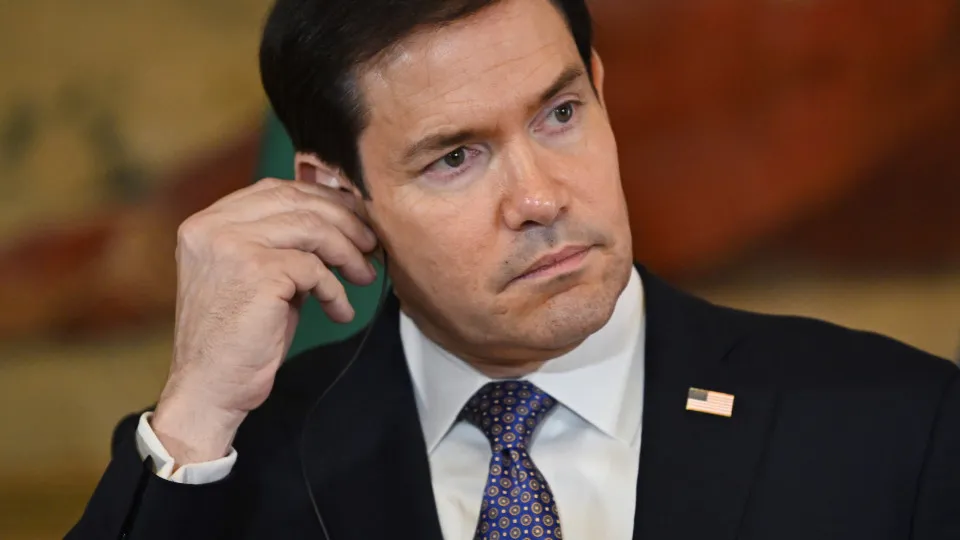
The U.S. Secretary of State Marco Rubio said today that economic pressure on Iran makes a new military offensive unnecessary, but he accused Tehran of presenting “absurd” conditions for a peace agreement.
© Zed Jameson/Anadolu via Getty Images
10/11/2026
by
Lusa
O u.S. Secretary of State Marco Rubio said today that economic pressure on Iran makes a new military offensive unnecessary, but he accused Tehran of presenting “absurd” conditions for a peace agreement.
“ The economic pressure campaign against Iran is so devastating that there is currently no need for major combat operations,” Rubio said after a meeting of the G7 Foreign Ministers in Paris.
“ That is what he said to our allies today,” the head of US diplomacy added.
Rubio warned, however, that Washington maintains the possibility of resorting to military force if the Iranian authorities cross certain red lines.
“ Obviously, if Iran crosses certain red lines, if its regime does certain things that should not happen, the US Armed Forces, the most capable military force in the world, are prepared to respond,” Rubio said.
The Secretary of State also ensured that Washington remains available to negotiate an agreement to end the war, but held Tehran responsible for the lack of progress in the talks.
“Iran would very much like to reach an agreement. The problem is that the conditions you continue to present are absurd. At the moment, he does not even seem to be negotiating seriously,” said the US chief of diplomacy.
Rubio stressed that the United States remains willing to reach an understanding, highlighting Qatar's role in mediation efforts between Washington and Tehran.
“If there is a possible agreement, the President will be the first to support it. But it will not be an absurd agreement nor a bad agreement,” Rubio assured.
The statements arise at a time when the United States and Iran resumed indirect contacts through mediators such as Qatar in a new attempt to end the conflict that began with the US and Israeli attacks on Iranian territory at the end of February.
According to the most recent Iranian proposal, Tehran admits to reopening Ormuz's narrow strategy within two days of fulfilling various conditions.
Among the Iranian demands are the lifting of the US naval blockade, the restoration of oil trade, including Iran's exports, and a ceasefire on all fronts.
Rubio insisted, however, that the current economic pressure strategy is producing results and that Washington does not want to interrupt it.
According to the Secretary of State, the blockade imposed by the United States is causing a reduction in Iranian oil exports, while the US authorities are trying to prevent Tehran from circumventing sanctions.
Rubio considered that the worsening economic situation would eventually influence the decisions of the Iranian authorities, in particular because of difficulties in financing military and security structures.
The head of US diplomacy has therefore argued that there is no reason to interrupt the economic pressure campaign by means of a further major military intervention.
The statements arise after President Donald Trump said on Monday that there is a momentum in favour of reaching an agreement to end the war with Iran.
The US President considered that Iran is “militaryly finished”, but admitted the possibility of a diplomatic understanding to prevent the return of hostilities on a large scale.
In a message published on the Truth Social network, Trump stated that a new wave of attacks against Iran is “not likely”, although he stressed that the United States remains “prepared to intervene.”.