
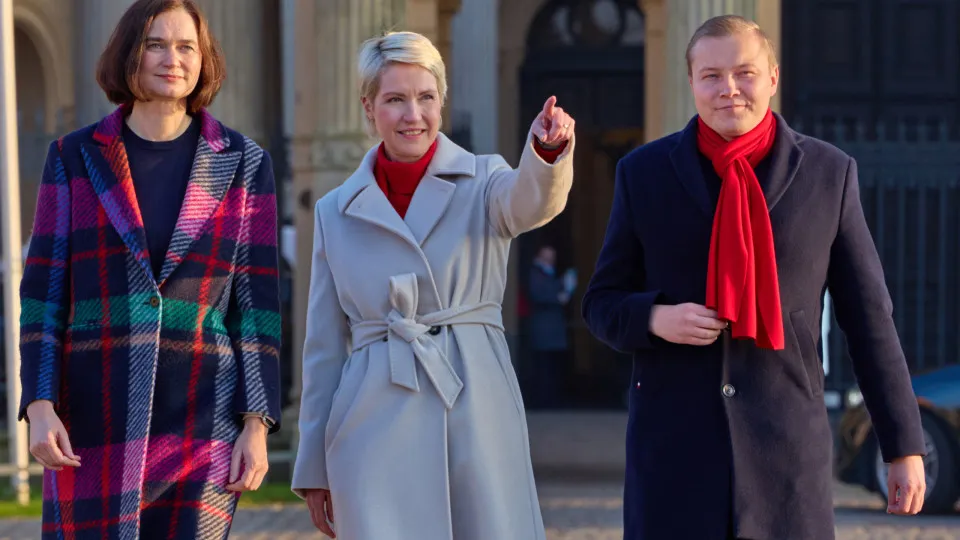
The Prime Minister of Mecklenburg-Western Pomerania, Manuela Schwesig, reached an agreement to continue governing the federated state, leading a tripartite coalition with SPD, Left and Greens.
© Jens Büttner/picture alliance via Getty Images
10/11/2026
by
Lusa
A prime Minister of Mecklenburg-Western Pomerania (north-east Germany), Manuela Schwesig, today reached an agreement to continue governing the federated state, ahead of a tripartite coalition which will include, in addition to its SPD, The Left and The Greens.
“ They were intense negotiations, which lasted through the night,” said the governor at a press conference in Schwerin (northeast).
Its re-election as Prime Minister by the regional parliament is due to take place next Monday, while the signing of the agreement is scheduled for Saturday, after approval by the competent bodies of the three parties, which is considered only a formality.
In the regional elections of 20 September, the Social Democratic Party (SPD) ranked second, with 35.5% of the votes behind the far-right Alternative Party for Germany (AfD), which won, with 38.2%.
The Party The Left obtained 6.5% of the votes, and The Greens, 5.7%.
In the last legislature, Manuela Schwesig ruled in coalition with the party The Left, but the results of these regional elections forced it to add The Greens to the alliance, so the AfD will be the only parliamentary group in the opposition.
In the vote of 20 September in Mecklenburg-Western Pomerania — as in Berlin on the same day, and in Saxony-Anhalt two weeks earlier — the Christian Democratic Union (CDU), the conservative party of the German Chancellor, Friedrich Merz, suffered a strong defeat, falling below the threshold of 5.0% of votes, which means that it will not have parliamentary representation – a fact unprecedented in a federal state (Land), in the history of the country since 1945.
These regional defeats have fueled speculation about Merz's early retirement, but he has already said that he will not resign and that he will maintain his coalition with the Social Democrats for democracy in Germany.
In a country still haunted by its Nazi past, traditional parties maintain what is called a “healthy cord” (or “wall of protection” in German) against the far right, refusing to form alliances with it to prevent it from coming to power.
However, in Saxony-Anhalt — also located in the former GDR — AfD seems to be in a favourable position to govern one of these 16 regional states for the first time in post-war Germany after having won 44% of the votes.
In Mecklenburg-Western Pomerania, coalition negotiations between the three parties took about four weeks and were led by Manuela Schwesig, SPD, Hennis Herbst, party The Left, and Claudia Müller, by the Greens.
The negotiating process took place without major debates, contrary to what happens in the city-state of Berlin, where the same three parties are still trying to reach an agreement to govern.
A central difference between cases is that in Berlin the party The Left (Die Linke) was the most voted, and a coalition would pave the way for its candidate, Elif Eralp, to be elected president of the governing chamber.
To this are added particularities of the federal capital, where part of the party The Left is under suspicion of maintaining contacts with pro-Palestinian groups close to the Palestinian Islamist Hamas movement and with members of Arab criminal clans.
In addition, in Berlin, there is also the alternative of another tripartite coalition, led by the CDU and counting on SPD and The Greens as partners.
Present Defense Minister Boris Pistorius, former Health Minister Karl Lauterbach, former Mayor of Berlin, Franziska Giffey, and Foreign Minister and former SPD President Sigmar Gabriel, signed an open letter signed by more than a thousand Social Democratic militants rejecting a coalition of the SPD with The Left in Berlin.