Taiwan holds local elections testing support for President William Lai and the opposition strategy in a context of Chinese military pressure.
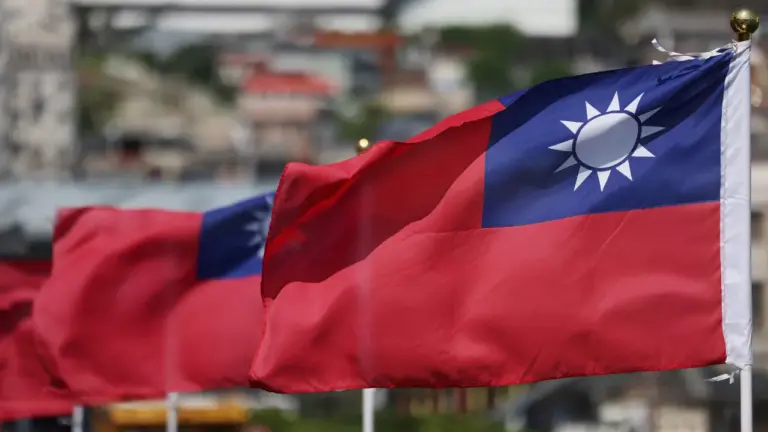
© I-Hwa Cheng / AFP via Getty Images
25/11/2026
by
Lusa
Taiwan holds local elections on Saturday which test the popularity of President William Lai and the strategy of cooperation between opposition parties, two years from the presidential, in a context of increasing Chinese military pressure.
Almost 20 million voters are called to the polls to choose 11,051 public office holders, including those responsible for the local governments of the island's 22 cities and counties, as well as members of municipal assemblies and other local representatives.
The Progressive Democratic Party (DPP), in power since 2016, has been seeking to regain ground against the Kuomintang (KMT), the main force of the opposition, which won in 14 cities and counties in the last municipal elections in 2022, against five conquered by the ruling party.
Voicing should also make it possible to assess the effectiveness of the electoral alliance between the KMT and the Taiwan People's Party (TPP), which agreed not to present competing candidates in various districts and which jointly control the island's parliament.
Although relations with Beijing usually dominate the presidential elections, issues such as housing costs, public transport, care for children and the elderly and local economic development marked the campaign for local authorities.
Analyst Lucy Best, in an article published by the U.S. National Bureau of Asian Research (NBR), warned, however, that the results of local authorities should not be extrapolated directly to the president of 2028.
The KMT has a strong local mobilization capability, but lost the last three presidential elections, while the DPP suffered losses in the local authorities of 2018 and 2022, before winning the Presidential elections of 2020 and 2024.
The results will offer “an important window on Taiwan’s political landscape, but not necessarily a direct forecast of national policy in 2028,” Best wrote.
Elections for the governments of the six major cities of Taiwan – Taipei, New Taipei, Taoyuan, Taichung, Tainan and Kaohsiung – are of particular importance as they constitute a platform for political rise at national level.
Four of the five Presidents elected by direct suffrage since the démocratisation of Taiwan previously held office in front of one of the main cities on the island, including Lai, former mayor of Tainan.
In the capital, Taipei, the current mayor, Chiang Wan-an, of the KMT, disputes re-election with the deputy of the DPP Puma Shen, expert in national security and known for his work in combating Chinese misinformation.
Shen became one of the main targets of Beijing's criticisms, which accused him of defending Taiwan's formal independence and imposed sanctions against the politician.
In New Taipei, the island's most populous city, with about 3.4 million registered voters, the MP of the DPP Su Chiao-hui faces Lee Shu-chuan of the KMT in one of the main electoral duels.
The DPP also seeks to conquer Taichung in the center of the island and preserve its traditional bastions of Tainan and Kaohsiung in the south.
The campaign takes place in a context of political impasse between the Presidency and Parliament, which has made it difficult to adopt measures proposed by the Government, particularly in the field of defence.
Victoria S. Zhou, researcher at the Frankfurt Peace Research Institute (PRIF), considered, in an analysis published last week, that local authorities may have consequences for the opposition parties' national security strategy.
“The first test comes with important defense budgets in early 2027,” Zhou wrote.
while Taiwan's main political forces share the island's defence of peace and democratic autonomy, there are deep differences regarding the relationship with Beijing and the strengthening of Taiwanese military capabilities.
The DPP favours strengthening Taiwanese identity and a strategy of military deterrence against China, while the KMT advocates closer approach to Beijing and maintaining channels of dialogue through the Taiwan Strait.
Lai warned, at the end of October, of possible attempts at Chinese interference in elections, through misinformation campaigns, the use of artificial intelligence and the mobilization of local collaborators.
Beijing has previously rejected the accusations of interference in the Taiwanese electoral processes.
According to the Taiwan Central Electoral Commission, the counting of votes should be completed by midnight on Saturday (16:00 in Lisbon).
Taiwan has been autonomously governed since 1949, when the Kuomintang nationalist forces took refuge on the island after the defeat of the Chinese civil war against the Communists. Beijing considers Taiwan is part of its territory and does not exclude the use of force to achieve reunification.