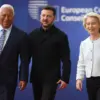
EU leaders meet in Brussels to discuss the EU budget for 2028-2034, Ukraine’s funding in 2027 and the succession in leadership of the European Central Bank.
© Shutterstock
24/11/2026
by
Lusa
Othe Heads of State and Government of the European Union meet Thursday and Friday to discuss the proposal for a Community budget for 2028-2034, Ukraine's funding in 2027 and the succession in the leadership of the European Central Bank (ECB).
The extraordinary meeting of the European Council, held in Brussels and convened by the President of the institution, António Costa, aims to make progress in negotiations on the next Multiannual Financial Framework (MFF) of the European Union (EU), days after the former Portuguese Prime Minister presented a compromise proposal to try to bring the positions of the 27 Member States closer to the bloc.
“ We are now closer to a political agreement,” said a senior European official in the forecast of the extraordinary meeting.
Another European source added that this high-level meeting, marked by several bilateral meetings on the sidelines, will be “organised on the basis of a hypothesis, however small, of agreement”.
Presented last Saturday, António Costa's proposal provides for a budget of EUR 1.780,9 billion, at current prices (1.585,5 billion at constant prices of 2025), below the EUR 1,984.9 billion initially proposed by the European Commission (1.763,1 billion at constant prices of 2025).
There are cuts in various areas, such as cohesion.
The proposal seeks to limit the financial effort of countries, to preserve areas such as agriculture and to strengthen the sources of financing of the Community budget by creating new own resources, which could generate around EUR 60 billion per year, including a 3% rate on certain digital revenues of large enterprises.
The proposal also includes mechanisms for phased introduction of certain contributions, including those associated with emissions trading and tobacco, to mitigate the impact on the most affected Member States.
The President of the European Council also proposes to change the repayment profile of loans contracted under the post-pandemic recovery fund by releasing budgetary capacity for investment in Community priorities.
Portugal is expected to lose around EUR 400 million at current prices with the Costa proposal in the face of previous versions, to an allocation of EUR 34.9 billion, and to ask for funds for the autonomous regions of the Azores and Madeira.
At constant prices of 2025, the proposed amount for Portugal is now EUR 31 billion.
The 27 will seek to bring positions closer to the budget proposal with a view to a political agreement by the end of the year, which will have to be unanimously approved and validated by the European Parliament.
Another central theme will be Ukraine's funding in 2027, with the European Commission proposing another EUR 45 billion to cover around two thirds of the financial needs identified for Ukraine.
Leaders should also discuss the need to ensure sustainable financing for Kiev in the future, including in the next EU MFF.
The succession in the Presidency of the ECB should also be among the political issues under discussion, at a time when Christine Lagarde announced that she would leave the office of President on 7 February 2027, anticipating the initial departure scheduled for October of that year.
The two candidates presented for the succession are the Spanish Pablo Hernández de Cos, former governor of the Bank of Spain and current director-general of the Bank for International Settlements, and the Dutch Klaas Knot, former governor of the central bank of the Netherlands.
The choice of Lagarde’s successor should be articulated with two other appointments for the ECB’s executive committee, namely the positions held by Isabel Schnabel and Philip Lane, whose mandates expire in January and May of next year, respectively.
Germany submitted the candidacy of economist Markus Brunnermeier, while France advanced by the name of Laurence Boone, former French Secretary of State for Europe.
The meeting of Thursday will be the last high-level of the current President of the ECB before leaving office.
The extraordinary meeting of the European Council will take place for two days, beginning on Thursday, at 10:00 a.m. in Lisbon.
On the eve, on Wednesday, António Costa and the President of the European Commission, Ursula von der Leyen, meet in Brussels with the leaders of the Western Balkans to highlight the “positive momentum” in Montenegro’s and Albania’s accession negotiations and try to capitalise on the dynamics generated by the recent elections in the region, particularly in Serbia, where a student movement has won.