One of the presidents of Chinese electric car manufacturer Xpeng, Brian Gu, believes that the company's humanoid robots will arrive at customer homes somewhere for the next two years.
© Getty Images
27/11/2026
by
Miguel Patinha Dias, Lusa
Um of the presidents of Chinese electric car manufacturer Xpeng, Brian Gu, believes that robots can start dealing with tasks at home – such as washing dishes or doing laundry for the next two years.
Gu was talking to the American publication CNBC, indicating that arrival at customer homes will take place after the humanoid robots developed by Xpeng reach commercial contexts.
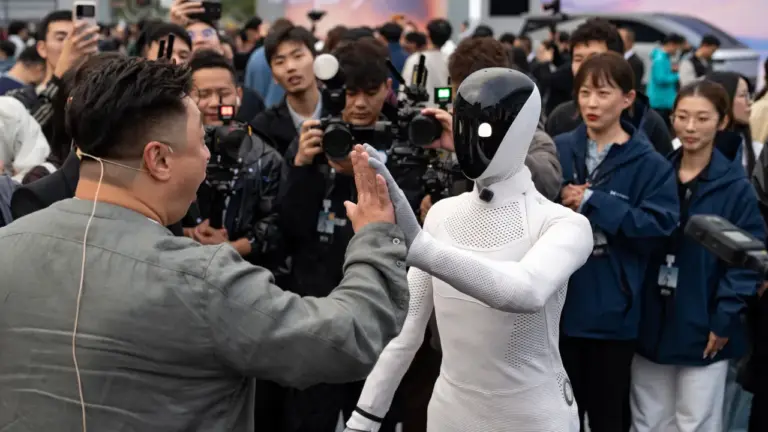
Xpeng officially revealed this Wednesday the latest model of its commercial robot – called Iron – and confirmed that it intends to start training it to be used as an assistant in its stores. These robots will begin to be mass produced in January and can be found in the brand stores in the first quarter of next year. Robot sales will start in the second quarter, with deliveries to be completed at the end of the year.
“Perhaps after a successful launch in commercial contexts, perhaps another one or two years, we can start thinking about launching also for homes”, Gu said. “Technology is moving at a much faster pace”.
Humanoid robots are close to decisive advancement, says founder of Unitree
The founder of the Chinese manufacturer of Humanoid Robots Unitree, Wang Xingxing, said today that artificial intelligence (AI) applied to robotics may be close to a decisive advance, although technological and mass production difficulties persist.
During the business summit of the Asia-Pacific Economic Cooperation Forum (APEC) in Shenzhen, southeast China, Wang considered that recent progress in artificial intelligence brought the sector closer to a turning point, especially in the ability of robots to perform tasks in unknown environments.
Cited by the Chinese economic information magazine Caixin, the entrepreneur described as “enthusiasming” the technological advances that are taking place in laboratories, but that are not yet visible to the public.
“ Many of the progress that ordinary people observe in AI and embedded intelligence are just above the surface. What happens below the surface is very exciting and allows us to realize the enormous potential of the coming years ", he said.
Wang explained that one of the main obstacles remains the ability to generalize AI models, i.e. the possibility of a robot performing different tasks and adapting to new environments without further training.
“ We hope that a robot can reach any home and start working immediately, without having to be trained again whenever changing environment ", said.
The founder of Unitree considered that technological advances this year indicate that the sector may be close to overcoming this limitation.
However, it warned that a significant improvement in AI models will pose new challenges to industry, including in the production capacity, reliability of equipment and technical assistance services.
“ Today, we can produce some tens of thousands of robots a year. But if in the future we have to produce millions or tens of millions, the challenge will remain enormous,” he said.
Wang also warned of the growing needs of computer processing capability, which could greatly exceed current expectations as well as robot safety issues.
Unitree, founded in 2016 and based in Hangzhou, Zhejiang, became one of the leading Chinese manufacturers of humanoid robots and quadrupeds.
The company develops models such as G1, launched in 2024, and has sought to extend the use of its equipment to factories, services and home environments.
In August, Wang stated that the sector could reach in the coming years a time comparable to the launch of ChatGPT in 2022, when robots are able to perform most of the tasks in unknown environments by simple voice or text instructions.
At the time, the entrepreneur estimated that this advance could occur within two to three years, in an optimistic scenario, although he admitted that it could take between five and 10 years.
China has placed humanoid robotics among its industrial priorities, seeking to develop machines capable of replacing workers in repetitive, dangerous or physically demanding tasks, in the context of ageing the population and reducing the workforce.
Despite technological progress and increasing investment in the sector, humanoid robots continue to have limitations on efficiency and autonomy that hinder their large-scale commercial use.