
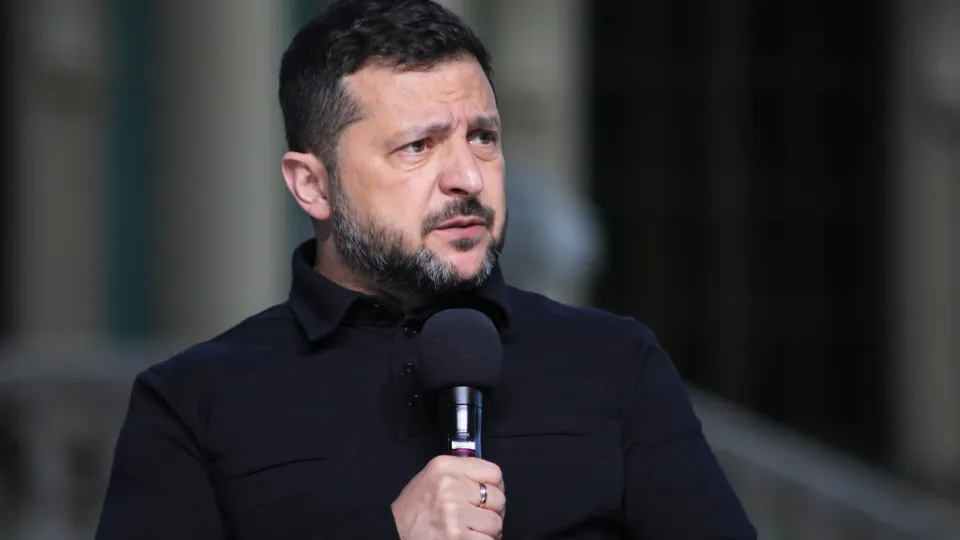
The Ukrainian President announced that he will meet on Thursday in Dublin with US emissaries Steve Witkoff and Jared Kushner, who will be scheduled to travel to Moscow first for talks with the Russian Head of State.
© Yuliia Ovsiannikova/ Ukrinform/Future Publishing via Getty Images
11/11/2026
by
Lusa
O Ukrainian President announced today that he will be meeting on Thursday in Dublin with US Special Envoys Steve Witkoff and Jared Kushner, who will be travelling to Moscow first for talks with the Russian Head of State.
“ The US representatives are moving to Russia and after that discussion we will coordinate our positions again and determine what other steps are possible. We will meet them tomorrow [Thursday] in Dublin,” Volodymyr Zelensky said on social network X.
The Ukrainian leader's announcement comes after today's trilateral talks between Kiev, Moscow and Washington in Abu Dhabi in the United Arab Emirates (UAE).
During the two days of direct talks in Abu Dhabi — the first in more than eight months — the parties agreed on a new exchange of prisoners, although they differed as to the role that Europe should play in continuing negotiations.
Although few concrete elements have emerged from these discussions aimed at finding a way out for the almost five years of war, the parties have said that progress has been made and that negotiations will continue.
At a press conference, Jared Kushner, the American President’s son-in-law, Donald Trump, announced that he would travel to Moscow on Thursday with Steve Witkoff to meet Vladimir Putin and “take stock of what was discussed” in Abu Dhabi and “try to make progress.”.
“ After that, we will go to Dublin to meet President Zelensky, take stock of him and deepen some of the ideas we have presented,” he added.
Zelensky confirmed moments later that he was meeting with the American emissaries on Thursday in Dublin.
“We will recoordinate our positions and determine what other steps are possible,” said Ukrainian head of state on X.
On the Russian side, the head of the Kremlin delegation, Vladimir Medinski, said that the dialogue will continue.
The head of the Ukrainian delegation, Rustem Umerov, noted, however, that there are still “important differences”, while stressing that there are “possibility to continue the negotiation process”.
Ukrainian negotiators met with European representatives and US emissaries after the end of negotiations with Russia.
On Tuesday, Washington and Kiev considered that negotiations should be extended at some point to Europeans who support Kiev.
Volodymyr Zelensky today welcomed his inclusion in the negotiations, stressing that this had not been easy.
On Tuesday, Zelensky had called on Europe to appoint a representative for the negotiations in November.
However, Russia, which has so far sought to remove Europe from discussions, does not seem to have changed its position in this regard.
Even today, the head of the Russian delegation, Vladimir Medinski, dismissed the idea of negotiations between Moscow and Europeans, saying “not understanding their role well”.
“We have not received any peace initiative, nor any concrete proposal from European countries, so it is very complicated to know what to discuss,” he added.
As regards concrete results, Kiev, Moscow and Washington announced that a large-scale exchange of prisoners would soon take place between Ukraine and Russia.
Jared Kushner assured that it would be the “greatest humanitarian release of prisoners” in this conflict, stating that the number of detainees exchanged would be set on Thursday.
Zelensky had stated on Tuesday that he wanted “an exchange of 1,000 [prisoners] for 1,000, or even 1,500 for 1,500”.
The exchange of detainees and dead military bodies is one of the few areas of regular cooperation between Kiev and Moscow.
As for the steps to be taken to advance the negotiations, Kiev demands the end of the hostilities and “security guarantees for Ukraine established” before further discussions on security in Europe.
Jared Kushner thus appealed on Tuesday to a new security framework for Ukraine and Russia, but also for Europe, in order to ensure “decades, or even centuries, of peace”.
Before any ceasefire, Moscow's position has been to demand an agreement on territorial issues and the creation of a new security architecture in Europe.