
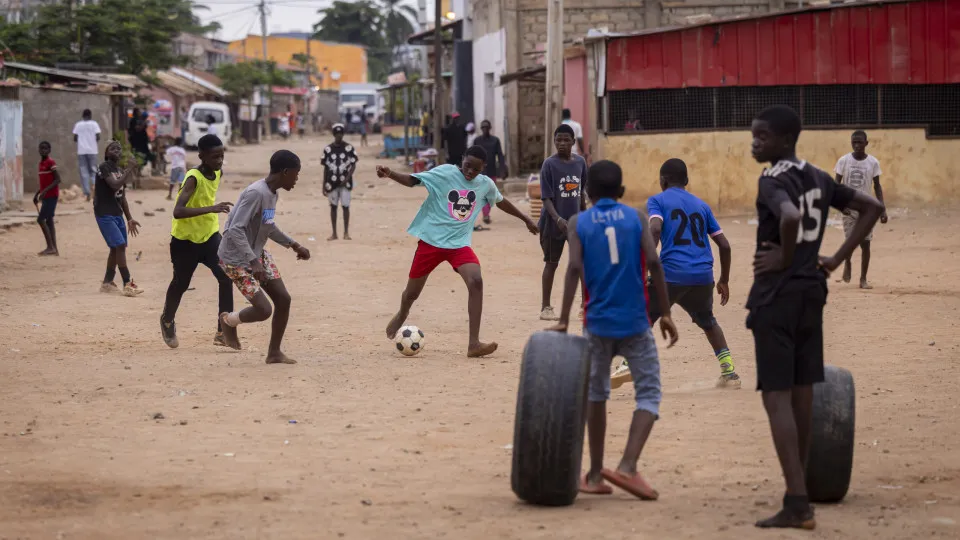
Angola has nearly 13 million poor children who face, in addition to the lack of money, deprivations in various areas, from education to nutrition or drinking water, according to the Multidimensional Poverty Index, released today in Luanda.
© Lusa
17/11/2026
by
Lusa
Angola has nearly 13 million poor children who face, besides the lack of money, deprivations in various areas, from education to nutrition or drinking water, according to the Multidimensional Poverty Index, released today in Luanda.
For the first time, the country has conducted a statistical study in which, in addition to the national general data, it specifies the condition of women and children in the Multidimensional Poverty Index for the period 2023/2024.
The report presented today shows that 44.8% of the approximately 36 million Angolans live in multidimensional poverty, deprived not only of income but also of basic services such as health, education, electricity, sanitation, drinking water or housing.
For the first time, as highlighted by the president of the National Institute of Statistics (INE), Joel Futi, the data allow a deeper understanding of the deprivations that specifically affect children and women.
“69% of children, 12.8 million, live in a situation of multidimensional poverty”, and the main deprivations “focus on access to vaccination and disease prevention, cognitive development and housing”.
For women, more than 59% are in multidimensional poverty, being among the main deprivations “financial autonomy, housing and access to sanitation”.
“ These data reinforce the need to intensify investments in primary education, maternal child health care, social protection, economic autonomy of women and the promotion of equality and opportunities ", pointed out.
The results in the Index show progress, he stressed, pointing out that it went from 52% in the period 2015/2016 to 44.8% in 2023/2024. “However, they also show that important challenges persist particularly in rural areas and in the fields of education, health, sanitation, education, employment and access to electricity and drinking water,” he admitted.
The document, the president of the INE pointed out, “is a strategic tool for the knowledge of social reality in Angola” and the definition of public policies to reduce poverty and social inequalities, in a country where “poverty continues to be one of the greatest challenges”.
“ The report should not be assumed as a statistical publication, it should be assumed as a support instrument”, he emphasized.
The Multidimensional Poverty Index 2023/2024 was prepared by the INE in partnership with Oxford Poverty and Human Development Initiative (OPHI), the United Nations Children's Fund (UNICEF) and the United Nations Development Programme (UNUD).
UNICEF representative at the document presentation ceremony, Louise Moreira Daniels, highlighted the importance of the step Angola takes with this instrument.
“Poverty conditions all other goals. A deprivation in nutrition or the lack of school, leaves marks for the whole life in children, so it is so important that Angola now has an official measure of poverty, especially of the child ", said.
For UNDP representative Gabriel Dava, “the true value of this report, rather than presenting numbers, must (be) help Angola answer fundamental questions.”.
“ Who is falling behind in the development process, where there are the greatest deprivations and where efforts and investments should be concentrated to produce greater impact ", pointed out.