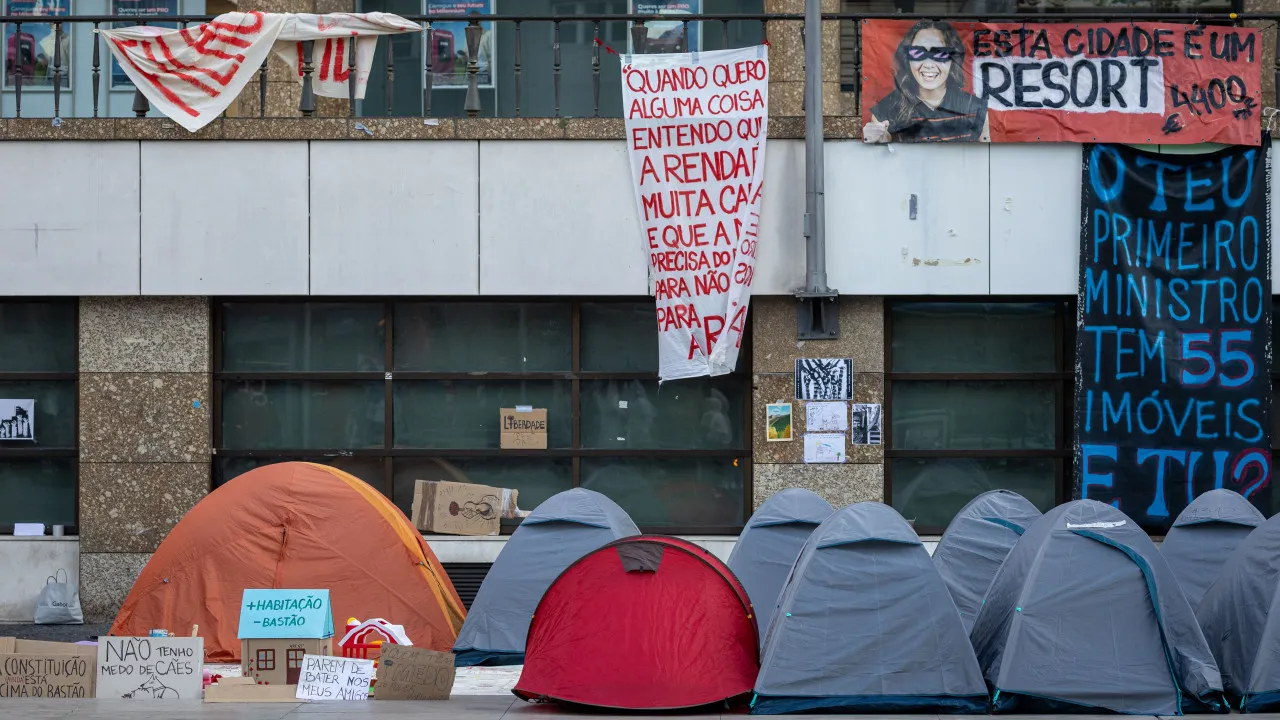
Over the last month and a half, there were dozens of homeless people who met in D. João I Square, where on October 10th the Port Camp, a refuge not to sleep in the open.
© Diogo Baptista/SOPA Images/LightRocket via Getty Images
22/11/2026
by
Lusa
Aover the last month and a half, there were dozens of homeless people who found in the square D. João I, where on October 10 the camp of Porto, a refuge not to sleep in the open.
David, 52 years old, spent two years camping in Colonel Pacheco's Square in Porto, until the Municipal Police, the third week of demonstrations in D. João I Square, forced him to dismantle the tent under the pretext that he would be incurring the counter-order of "wild camp".
He therefore decided to join the Campada, considering it “Ironic” to find shelter only in a protest for housing.
“I would like someone to find a solution for this, whoever it is, because this is no life for anyone,” Lusa said, rejecting the option of living in hostels: “I like to be quiet in my life. I see no solution to that.”.
Asked about the reasons why he was in a homeless situation, to which he had no “any problem answering,” David recalled the short family history.
“ Unfortunately, my family is missing. I worked in the hotel business from 10 to 23. Then my mother died. Then my father died. Then I had problems with drug addiction and I saw myself living on the street ", summarized.
David considers that the atmosphere in the Porto Camp is welcoming, as “there is no contempt, everyone is calm”, which does not mitigate the “sadness of having to be in such a situation”.
“I never thought I would have to go to this,” he confided, stressing that, at the moment, the protest is his “last refuge”, hoping that the camp will come out “at least one resolution”.
“I am on their side,” I told Lusa, concluding that “it’s a shame to have had to come to this.”.
Hossem is 40 years old and arrived in Portugal in 2023, but since he arrived here he has lacked “luck”, the word he shares most with Lusa.
Born in Tunisia, he has a regular situation in the country and came to work, whatever it is, and in the first two years it was difficult to find work “to make discounts”.
“ He still did not speak good Portuguese, and it is more difficult for foreigners ", he said.
He has worked mainly in construction, and for three weeks he has camped next to the protest for housing in Praça D. João I – the work is little, intermittent, and not always well paid, or paid at all.
“ I thank God, because I sleep peacefully, I like to work, I just want to work. I haven't had any luck. I want to make a family. Bad luck”, lamented.
On the other side of the square, Marco's tent and his girlfriend, whose name he didn't want to reveal to Lusa, has been housing the couple for 15 days.
“ We've been staying here because there are a lot of associations here that we're trying to figure out if they can help us. In the meantime, we fall on the street, and the prices of houses and rooms are absurd. We are trying to get a hand, so we can live together”, said the man, 47 years old.
Half a year ago, they stayed on the street and have been sleeping “around in hostels, under a building” or, like now, camping, and so far “by chance” have never had problems with authorities.
“ Here we have those who help us to maintain food, hygiene as much as possible, they support us ", admitted.
The couple is an example of many who, besides sleeping there, get a daily meal, estimating several members of the organization who have been staying there for weeks, dozens of homeless or homeless people, including cases of evictions.
The protest came to ‘discover’ an unresolved problem and sometimes invisible reality, in a port where entrances to buildings, interiors of banks and even the airport serve as an improvised bed for many people.
In line for the popular canteen, which by the accounts of the organization comes to feed 200 to 300 people free of charge a day, there are many of these realities, there ‘centralized’.
Paulo, however, lives in Maia, in a rented garage where there is only light, “lack of water”, for which he pays almost half of the 200 and few euros he receives per month, since the sexagenário lost his job and was without support.
He goes to Camping to have a meal and take some more supplies, but it costs him that in Maia there are no “social answers”, says Lusa, and also “support for the public transport pass, as they do here in Porto”.