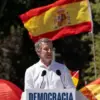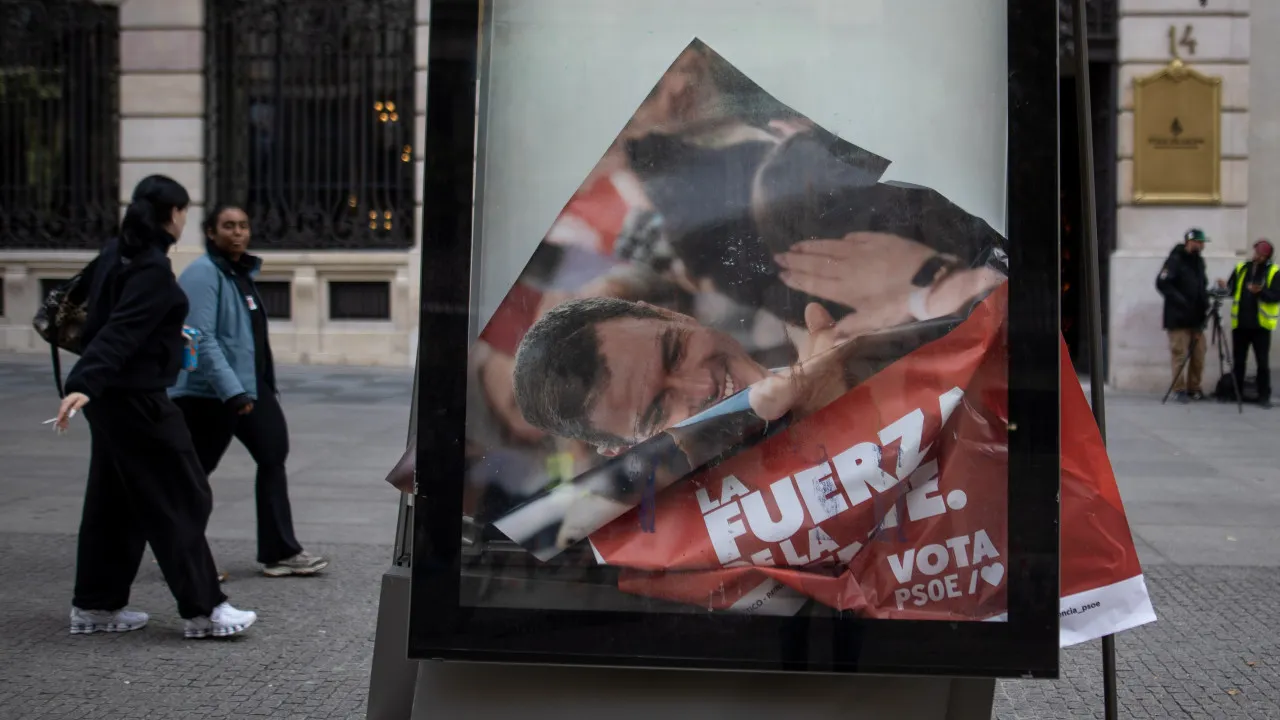
Spain chooses on 29 November the next government leader and polls and analysts predict that three winners of these parliamentary elections may emerge, although only one seems to have the possibility of being Prime Minister at the moment.
© David Canales/NurPhoto via Getty Images
22/11/2026
by
Lusa
ANDspain chooses on November 29 the next government leader and polls and analysts predict that three winners of these parliamentary elections may emerge, although only one seems to have the possibility of being Prime Minister at the moment.
“In the election night there may be two winners, Pedro Sánchez or Abascal, being Prime Minister Feijóo”, considers the former chief of staff of the current Spanish Prime Minister, former campaign director of candidates from different parties and today commentator and political analyst in Spanish media, Ivan Redondo.
Ivan Redondo's analysis is, he says, a reading of the polls of the elections, which give the People's Party (PP, right), led by Alberto Núñez Feijóo, as the most voted next Sunday, but without an absolute majority and with fewer votes and fewer deputies than in previous legislatives, July 2023.
In order to reach the Prime Minister, Feijóo will need to collide with Santiago Abascal, leader of the Vox, of the far right, the only of the national parties that grows in relation to 2023 and in a broad way, according to the polls, who estimate that it can reach 19% of votes and double the current bench of 33 deputies. The same studies reveal a continuous transfer of votes since 2023 from PP to Vox.
The current Prime Minister and leader of the Spanish Socialist Party (PSOE), Pedro Sánchez, will be the second most voted, but also with fewer votes and the election of fewer deputies than in 2023.
However, polls show a progressive increase in voting intentions at the PSOE since the election call on October 5, and a reduction in the difference between socialists and the PP.
According to the average polls, the difference between PP and PSOE has gone from six percentage points to just over three to one week of elections and there are even studies that indicate the possibility of ending up being the most voted party, if the trend continues.
In any of the most voted scenarios – PP or PSOE – polls now maintain that there will be an absolute clear majority of the popular with Vox, which can outperform the 190 MPs in a 350-seat parliament.
It is in this context that also for Guillermo Fernández, sociologist and researcher at the Complutense University of Madrid, Sánchez can aspire at this moment to a “sweet defeat” or, for Ivan Redondo, to be one of the winners of next Sunday’s election night.
This is even after arriving at these elections worn out internally by several confirmed and suspected cases of corruption of people close to him, by a legislative paralysis by relying on an eight-party contraption in parliament that prevented him from presenting a single proposal for a State Budget since 2022, by acting in the summer crisis in Ceuta or by two accidents in the high-speed train network in which 115 people died.
Sánchez’s political curriculum is that of a “survivor”, often against all expectations.
Born in Madrid on 29 February 1972, Sánchez is a PhD in Economics and has done his studies in the Spanish capital and Brussels. He was a university professor, an adviser to the European Parliament, a member of the Office of the High Representative of the United Nations in Bosnia during the war in Kosovo and speaks fluent English and French.
He has been a member of the PSOE since 1993 and became a deputy for the first time in 2009, after being a councilman in Madrid.
The leader of the PSOE arrived in 2014 and lost twice elections, with the worst results the party had in the history of Spanish democracy established in 1977.
The party came to expel him from the leadership in 2016, but returned to office in May 2017, surprisingly, in a candidacy against the device and the PSOE barons.
In June 2018 he became Prime Minister without going to elections, at a time when he was not even a congressman and when the socialists had the smallest parliamentary group ever, by approving the first motion of censure to a government in the history of Spain.
He won two elections in 2019 and ended up leading the first coalition government of Spanish democracy, with the extreme left platform United Podemos (Somar since 2023).
He counted on the making possible of governments in parliament by Catalan and Basque independent parties, which is still worth his accusations of negotiating and making agreements with “enemies of Spain”.
The admirers boast of resistance, competitiveness and persistence, while critics point to irregularity, decisions contrary to what they promised and opportunism to continue ahead of the government.
Alberto Núñez Feijóo, born on September 10, 1961 in a village of 300 inhabitants of Galicia, presented himself in the elections of 2023 as a “political who did not want to be a politician” and in this year as “a manager”, who never had “a case of corruption” in the teams he appointed during the 16 years he was in charge of the Galician regional government.
Graduated in Law, he arrives at these elections with four absolute majorities for the PP in autonomic elections on the curriculum and also as the winner of the national legislatives of 2023, although he did not then get enough support in parliament to be invested Prime Minister.
He was a civil servant in Galicia and took the first post of political appointment in 1991 at a General Secretariat of the Regional Government.
He became PP leader in Galicia in 2006 and on 18 April 2009 he first took over the presidency of the regional executive.
Leads the national PP since March 2022 and since then the party has won most of the elections that have taken place in Spain in recent years. The PP currently governs 13 of the 19 autonomous regions and cities of the country.
Feijóo came to the leadership of the national PP with a moderate and dialogic image, of a right-wing politician, conservative and strict with public accounts, but with social concerns and little ideological.
This image has suffered damage in recent years because of the agreements that PP signed with Vox for coalitions in regional governments, as well as an approximation of positions to the right more radical in areas such as immigration or the environment.
Santiago Abascal, the third protagonist of the Sunday election, was born in Bilbao on April 14, 1976 and was a PP militant since the youth, a party for which he took several positions and functions, such as regional deputy in the Basque Country.
He left PP in 2013 and founded Vox at the end of that year. The far right party broke into the Spanish parliament in 2019 and is today the third largest political force in the national assembly.
Santiago Abascal remains president of Vox, but the party has changed since 2019, explains polytologist Pablo Simón of Carlos III University of Madrid: “The first Vox” was “a reaction” to the separatist process in Catalonia and was “clearly Spanish nationalism upset with the Popular Party” with “an ultra-conservative agenda on issues of gender violence, sexual minorities and a little immigration.”.
According to the polytologist, after some “purges” of leaders and the entry of other protagonists, a “second Vox” was born more recently, what is presented in these elections, with “a much more direct link with the extreme rights of the rest of Europe”, having “imported similar rhetorics” and, today, “whatever the theme is, in Vox everything goes through immigration”.