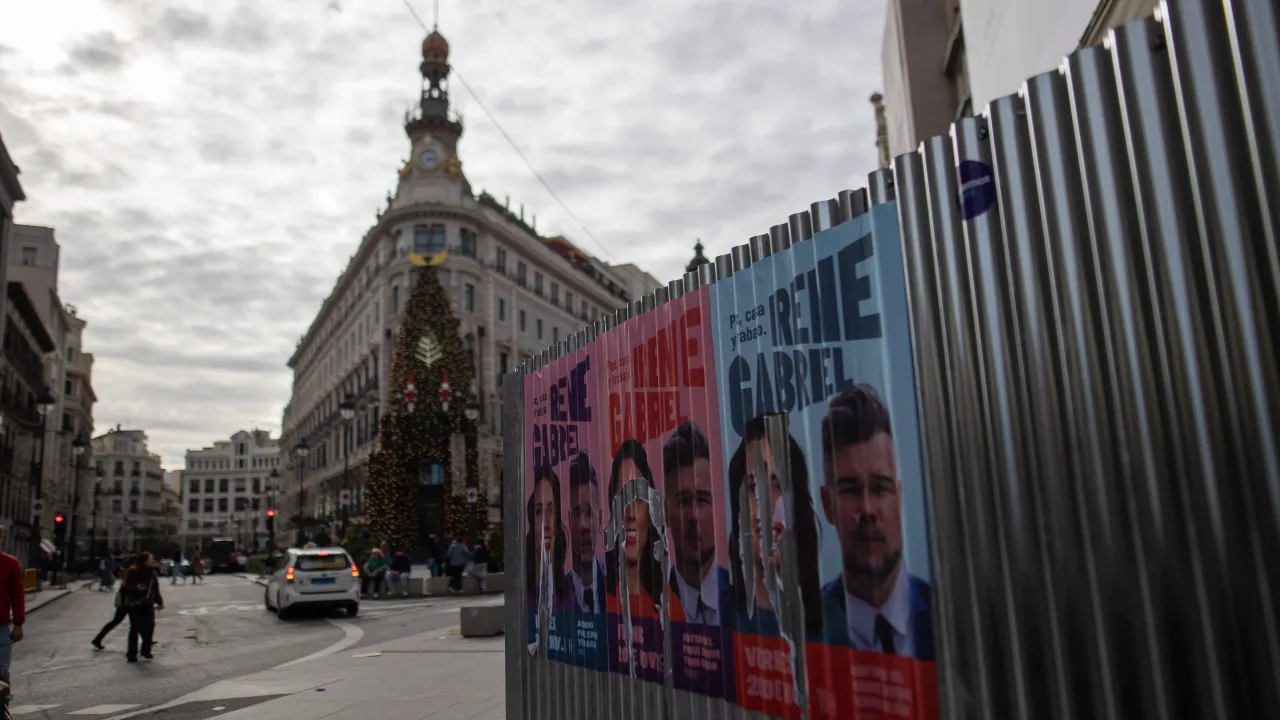
Spain goes to vote within a week with polls keeping the People's Party (PP, right) ahead but dependent on the Vox (extreme right) to be Government, in an election that polytologists classify as "essentially ideological".
© David Canales/NurPhoto via Getty Images
22/11/2026
by
Lusa
ANDspanha goes to votes within a week with polls keeping the People's Party (PP, right) ahead but dependent on the Vox (extreme right) to be Government, in an election that polytologists classify as “essentially ideological”.
The two parties have already joined this year to form governments in four autonomous regions and have assumed the willingness to form a coalition in the national executive to withdraw the left from power.
According to the same polls, Vox may approach 19% of votes and double the current bench of 33 Members.
It is, on the other hand, the only one of the four national parties that assume the goal or have the possibility of entering the next government, alone or related, which grows in relation to the previous elections, July 2023, when it had 12.3% votes, according to current projections.
After eight years of governments led by the Spanish Socialist Party (PSOE) and Pedro Sánchez, the polls coincide that the PP, by Alberto Núñez Feijóo, will be the most voted next Sunday, but without an absolute majority, as already happened in 2023, when an eight-party contraption ended up enabling a new left-wing executive.
The most recent studies indicate that the PP will lose a percentage of votes and Members compared to 2023, when it had 33% and elected 137 out of 350 seats in parliament.
The average of the most recent surveys is around 31% and 129 Members.
Nevertheless, the studies coincide with the fact that PP and Vox will achieve a clear absolute majority in parliament, this time, over 190 Members. In 2023, six Members of that absolute majority were left.
The PSOE, which in 2023 had 31.68% of the votes and obtained 121 Members, will again be the second party this year, but with a vote below 30% (about 28%) and also with fewer parliamentarians, according to average polls calculated by various media.
Socialists have shown an improvement in polls since the elections were called and there are up to two studies indicating the possibility of ending up being the most voted party on November 29, if the trend continues.
According to the average polls, the difference between the PP and the PSOE has narrowed since the early elections were called on October 5, and went from six percentage points to just over three.
The PSOE is, says the majority of studies, the party with the highest percentage of undecided electorate between voting to abstain, while right-wing voters are almost fully mobilized.
The socialists currently rule in coalition with the Somar left platform, which in these elections presents itself with the name Front Wide, but with fewer formations, which decided to choose their own lists.
The most recent polls give the Front Wide, led by former mayor of Barcelona, Ada Colau, less than 7% of the votes, after Somar achieved 12.33% in 2023.
“ We are in an essentially ideological campaign, it is essentially ideological elections”, says polytologist Cristina Monk, who stresses that polls are revealing that the electorate is not so much evaluating a management, rewarding or punishing the socialists in power, but showing an “adherence to an ideological bloc” (left or right).
The political scientist and sociologist points out that since the elections were called, “there is a very clear increase in the useful vote, both on the right and on the left”, and that all studies indicate that there will be a high participation, which can exceed 75% and be one of the three largest ever in legislative in Spain.
For Cristina Monge, one of the proofs that they are “a very ideological election” and “a left-to-right campaign” was the null impact on the polls of the Urda railway accident, in which 69 people died on October 28, in the early election campaign.
After four or five days in which “Spanish society was making a fool of itself, in which it was in shock”, the polls maintained previous trends and figures, without the PSOE, ahead of the government and responsible for managing services such as rail transport, being penalized.
Cristina Monge points out that, in the international context, these elections will serve, thus, to see what trend Spain is in, whether in the “line of the far-rights of the Iliberal rising” or “in the other trend that is related to Lula da Silva’s victory and the defeat of [Donald] Trump [in the American midways] and [Viktor] Orbán [in Hungary]”.
For the professor of Political Science and researcher at the University of Valencia Astrid Barrio, the leader of the PP, Feijóo, has, especially after the Urda accident, tried to debate the good and bad management of public services and money, but PSOE Secretary General Sánchez is “more comfortable in ideological debate” and has made the threat to rights, guarantees and “social advances” that represent the extreme right in power the main axis of the campaign.
Pedro Sánchez arrives at these elections worn out for eight years in the Government and also, in the last legislature, by several polemics and cases of corruption and a legislative blockade in parliament that led him not to present a single state budget.
“A poor balance sheet of the legislature” that probably makes him prefer the “very ideological” campaign in Astrid Barrio’s analysis.
In this campaign of blocs, the useful vote on the left is moving precisely to the PSOE, to the detriment of other parties to the left of the socialists, which happens, according to polytologist Pablo Simón of the University Carlos III of Madrid, after Sánchez had in the last legislature stolen very symbolic flags to this space, such as Palestine, the non-alignment with the United States of Trump or the refusal of NATO's demands in terms of military expenditure.